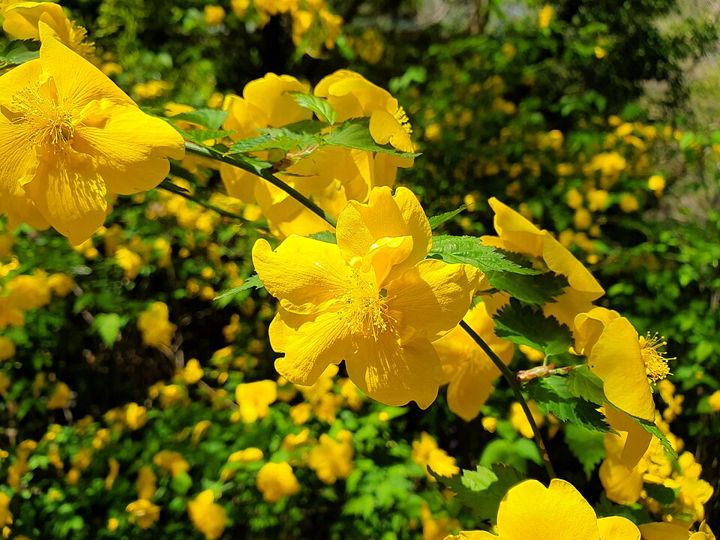
Photo: Syced, via Wikimedia Commons, public domain / CC0. Unmodified apart from resizing.
Colour
yellow
Region
Japan and temperate East Asia
Season
spring
Shape
single flower
Identification
A deciduous shrub 1–3 m tall with weak arching stems that often scramble over other plants or rocks; alternate simple leaves 3–10 cm long with doubly serrated margins. Golden yellow five-petalled flowers evenly spaced along the new green growth; the double cultivar 'Pleniflora' is commoner in gardens, and the Japanese name yamabuki is a traditional colour name. A dry achene 4–4.5 mm long. The only species in its genus.
Habitat
Wild in thickets on mountain slopes and by streams, and widely planted along garden, temple and park hedges.
Distribution
Native to China and Japan; common in the hills from northern to southern China and throughout Japan, where it is rooted in literature and colour culture (yamabuki-iro). Absent from Singapore.
Season and behaviour
Peak bloom in April and May alongside the late cherries, the new green shoots and golden flowers appearing together; the leaves yellow in autumn.
Photography tips
These are the FilmAnalysis editors' notes, not content from the sources.
The golden yellow is truest under cloud or diffuse light and bleaches in direct sun; the flowers strung along the branch suit compositions following the arch, compressed with a long lens. Yamabuki with stone walls and bamboo fences in Kyoto temples is the classic. Macro the layered petals of the double form, and the clean five petals and green leaves of the single.
Photographic styles
A string of gold along an arching branch; the yamabuki colour of a Japanese garden.
Similar species
Rhodotypos scandens (white four-petalled flowers, related); winter jasmine (earlier, square stems, six petals); forsythia (four petals, flowers before leaves).
Related badge
None yet. No validated photo recognition exists for this species, so no badge is tied to it: a name in the encyclopedia is not evidence in a photograph.
The illustration is original FilmAnalysis artwork. The photograph is from Wikimedia Commons; its licence and author are under it.
Why it is listed: this species comes from the Flower checklist (GBIF backbone and Wikidata verified). Names follow the GBIF backbone and Wikidata; the facts follow the sources below; photo recognition is not offered.