Japan and temperate East Asia, Singapore and tropical Asia
Season
summer, autumn
Shape
cluster
IUCN status
Least Concern
Identification
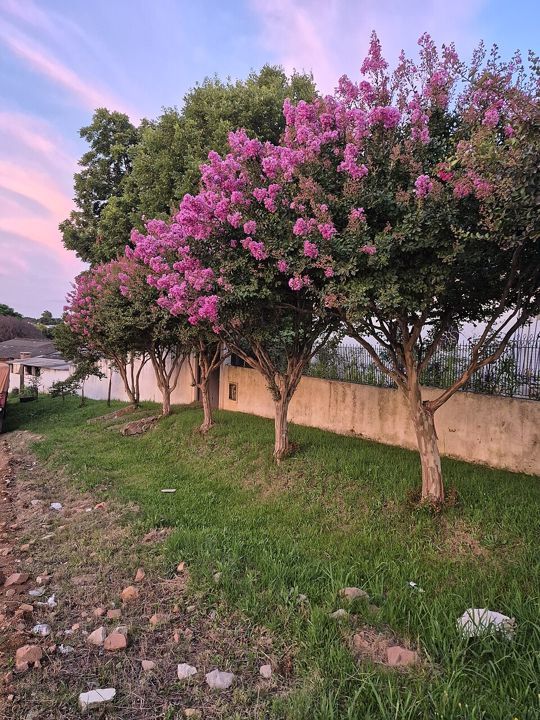
An often multi-stemmed deciduous small tree with a wide-spreading, flat-topped or rounded open crown. Bark thin, about 2 mm, smooth, pinkish-grey and mottled, shed each year, leaving the trunk bare, hence the Chinese nickname tickle tree. Small entire leaves, round or oval, dark green turning yellow, orange and red in autumn. Flowers white, pink, mauve, purple or carmine with crimped petals like crêpe, in panicles up to 9 cm; six-valved brown capsules follow.
Habitat
Gardens, streets, parks and temples; grown in China for thousands of years and planted in quantity in the Tang palaces of Chang'an; its modest height suits street planting. A tree nearly 1,400 years old stands in Yinjiang, Guizhou.
Distribution
Native to subtropical Asia: the Himalayas, southern China, mainland South-East Asia, Taiwan, the Philippines and Japan; widely planted across China and the city flower of Anyang, Xiangyang and others; common throughout Japan (hyakujitsukō, hundred-day red) and used as a street and garden tree in Singapore.
Season and behaviour
June to September, the display lasting a hundred days, hence the Chinese name; most striking in high summer when little else flowers. Autumn leaves red and yellow.
Photography tips
These are the FilmAnalysis editors' notes, not content from the sources.
The crêpe petals glow against the light, and a long lens compresses the panicle into one block of colour; the smooth trunk is a subject in itself, side-lit for the mottled bark and twisting limbs. Midsummer noon light is too hard, so shoot early or late; a summer blue sky is the ready background, pink against blue.
Photographic styles
Pink-purple clusters under a summer sky; the texture of a smooth trunk.
Similar species
Queen's crape myrtle (large leaves, larger purple flowers, tropical, a common Singapore street tree); Lagerstroemia subcostata (small white flowers, wild).
Related badge
None yet. No validated photo recognition exists for this species, so no badge is tied to it: a name in the encyclopedia is not evidence in a photograph.
The illustration is original FilmAnalysis artwork. The photograph is from Wikimedia Commons; its licence and author are under it.
Why it is listed: this species comes from the Flower checklist (GBIF backbone and Wikidata verified). Names follow the GBIF backbone and Wikidata; the facts follow the sources below; photo recognition is not offered.