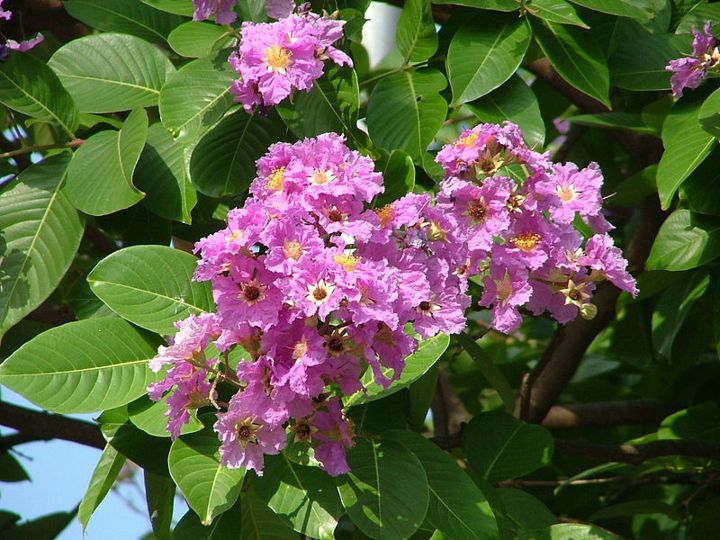
A large deciduous tree. Big oblong leathery leaves that turn red in autumn and winter before falling. Large flowers 5–7 cm across with six crinkled crêpe-like petals, bright pink to light purple, in big upright panicles that cover the tree; round woody capsules like small walnuts persist on the branches. The epithet means showy, and queen's flower comes from the old name flos-reginae. The leaves are used in the Philippines against diabetes.
Habitat
Tropical streets, parks and river banks, widely planted as a street tree; native to monsoon forest and riversides.
Distribution
Native to tropical South Asia, South-East Asia and Melanesia (India, Sri Lanka, Myanmar, Malaysia, Vietnam, the Philippines and elsewhere); one of Singapore's commonest street trees, grown in Guangdong, Guangxi, Fujian and Hong Kong, and in Japan only in Okinawa.
Season and behaviour
April to July in Singapore (a flush around each rainy season), May to July in southern China; about a month in flower, red leaves in autumn and dry capsules in winter.
Photography tips
These are the FilmAnalysis editors' notes, not content from the sources.
A tree covered in purple from below against blue sky, the purple truest in soft light and bluer in direct sun; macro for the crinkled petals and yellow stamens. Rows along a road compress with a long lens. The red autumn leaves and round woody fruit are the subjects of two other seasons; fallen flowers carpet the ground purple.
Photographic styles
A purple crown under blue sky; macro of crêpe petals.
Similar species
Crape myrtle (a small tree with small leaves and flowers, temperate); jacaranda (blue-violet bells, finely pinnate leaves); giant crape myrtle is an older name for this species.
Related badge
None yet. No validated photo recognition exists for this species, so no badge is tied to it: a name in the encyclopedia is not evidence in a photograph.
The illustration is original FilmAnalysis artwork. The photograph is from Wikimedia Commons; its licence and author are under it.
Why it is listed: this species comes from the Flower checklist (GBIF backbone and Wikidata verified). Names follow the GBIF backbone and Wikidata; the facts follow the sources below; photo recognition is not offered.