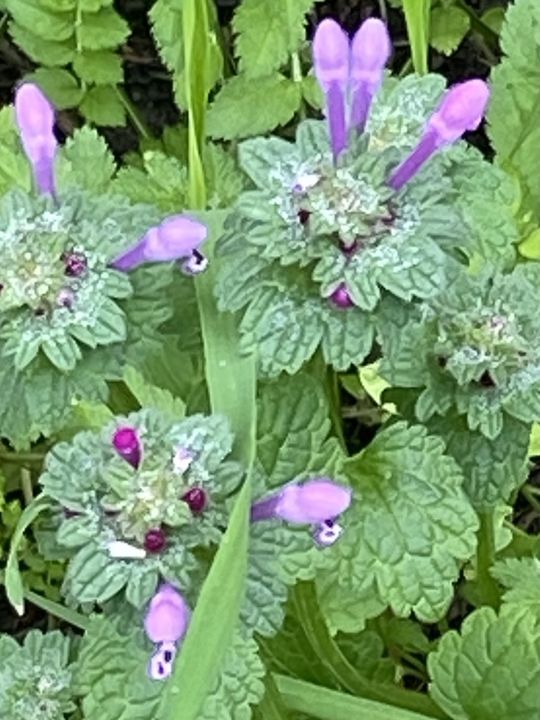
Photo: Ingo Renner, via iNaturalist, public domain / CC0. Unmodified apart from resizing.
Colour
pink, purple
Region
Japan and temperate East Asia
Season
spring
Shape
cluster
Identification
A low annual 10–25 cm tall (rarely 40 cm) with soft, finely hairy stems. Opposite rounded to kidney-shaped leaves 2–3 cm across with lobed margins and often long internodes; the lower leaves stalked, the upper stalkless, often fused and clasping the stem (the epithet means clasping), like tiers of canopies holding the flowers, which gives the Chinese name treasure-canopy herb. Flowers pink to purple, relatively large, 1.5–2 cm long, the purplish-red tube erect, the upper lip convex, the lower three-lobed; four stamens, two long and two short.
Habitat
Field edges, vegetable plots, roadsides, lawns and wall bases, one of the commonest small flowers of early spring, carpeting fields with speedwell and chickweed.
Distribution
Native to most of Europe, Asia and North Africa; common throughout China and Japan (hotokenoza, though the spring herb of that name is another plant). Absent from Singapore.
Season and behaviour
February to May, among the first wildflowers of early spring; from December in the south.
Photography tips
These are the FilmAnalysis editors' notes, not content from the sources.
The flowers are slender and upright, and only a side macro shows the rabbit-like lipped shape; get down to the ground with backlight through the purple-red corolla and the pale green of early spring behind. A purple field compresses with a long lens from low down. Frost or dew at dawn is best.
Photographic styles
Small purple-red flowers in early-spring fields; low-angle macro.
Similar species
Purple dead-nettle (denser whorls, purple upper leaves, taller); white dead-nettle (white or pale yellow, much larger); ground ivy (blue-violet, stalked kidney leaves).
Related badge
None yet. No validated photo recognition exists for this species, so no badge is tied to it: a name in the encyclopedia is not evidence in a photograph.
The illustration is original FilmAnalysis artwork. The photograph is from iNaturalist; its licence and author are under it.
Why it is listed: this species comes from the Flower checklist (GBIF backbone and Wikidata verified). Names follow the GBIF backbone and Wikidata; the facts follow the sources below; photo recognition is not offered.