Singapore and tropical Asia, Japan and temperate East Asia
Season
year-round
Shape
cluster
Identification
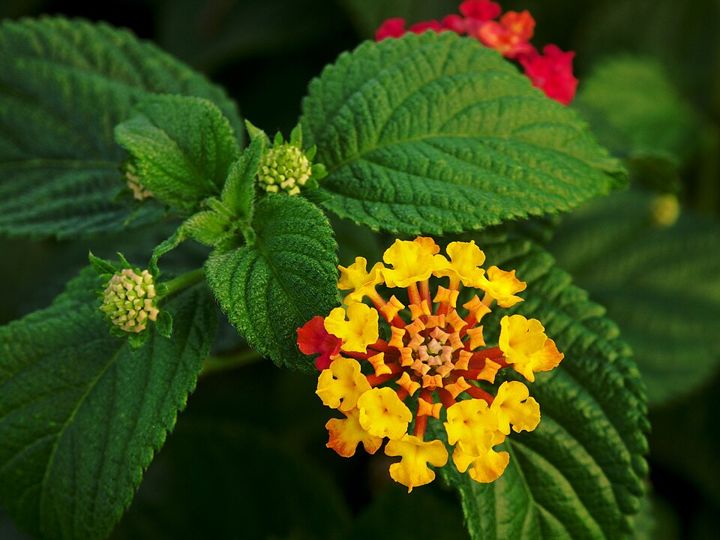
A perennial erect or sprawling shrub, usually about 2 m tall and up to 6 m when it scrambles into trees, forming dense thickets. Broadly ovate opposite leaves with a strong smell when crushed. Small tubular four-petalled flowers packed into terminal heads carrying red, yellow, white, pink and orange together, the colour varying with position, age and maturity and changing after pollination from yellow to orange, pink or red, thought to signal pollinators; hence the Chinese name five-colour plum. A tutti-frutti scent with a peppery note.
Habitat
Roadsides, waste ground, coastal scrub, forest edge and park hedges, extremely adaptable, spreading fast after introduction and invasive in about fifty countries; the whole plant is pungent and the berries poisonous.
Distribution
Native to the American tropics and West Indies, brought to Europe in the eighteenth century and spread worldwide. Very common in southern China, Taiwan and Singapore, where it is a favourite nectar source for butterflies; naturalised in southern Japan and Okinawa.
Season and behaviour
Flowers almost all year in the tropics, mid-April to the following February in Taiwan; the several colours in one head make it a subject for any month.
Photography tips
These are the FilmAnalysis editors' notes, not content from the sources.
The colour gradient within one head suits a macro taken straight down in soft light, since strong sun bleeds the orange-red. It is a butterfly canteen: wait at one clump in the morning for swallowtails and whites to land, at 1/1600 s. A deep green background keeps the tangle of stems from competing.
Photographic styles
Macro of many-coloured flower heads; butterflies with flowers.
Similar species
Trailing lantana (creeping, single pale-violet colour); other Lantana species (single-coloured).
Related badge
None yet. No validated photo recognition exists for this species, so no badge is tied to it: a name in the encyclopedia is not evidence in a photograph.
The illustration is original FilmAnalysis artwork. The photograph is from Wikimedia Commons; its licence and author are under it.
Why it is listed: this species comes from the Flower checklist (GBIF backbone and Wikidata verified). Names follow the GBIF backbone and Wikidata; the facts follow the sources below; photo recognition is not offered.