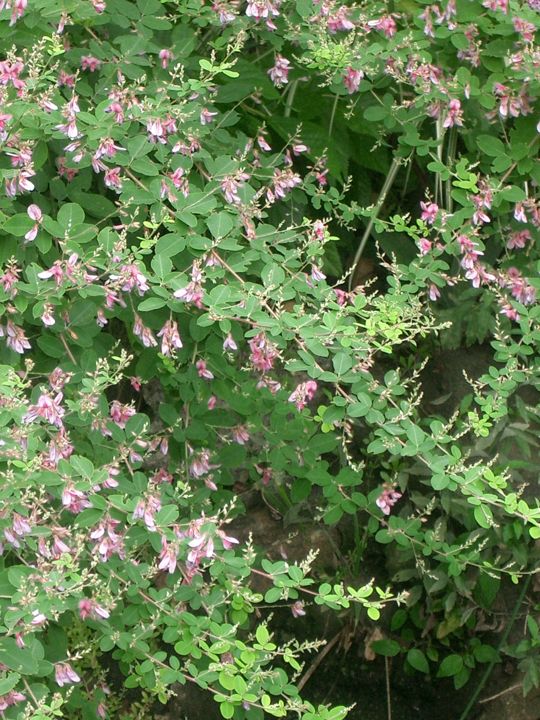
An erect shrub 1–3 m tall and as wide, smaller in cold climates, growing from the ground to 1.5 m in one season; a thick root system and stems up to 3 cm across. Leaves of three oval leaflets up to 5 cm. Racemes of up to 15 open pea flowers in pink and purple, plus cleistogamous flowers that never open. A flat pod nearly 1 cm long with one seed. Very variable, with many cultivars. The epithet means two-coloured.
Habitat
Hillsides, forest edge, roadsides and scrub, tolerant of poor soil; widely planted for ornament and erosion control and invasive in the south-eastern United States. Once used as pig fodder in rural China.
Distribution
Native to eastern Asia from south-eastern Siberia to eastern China, Mongolia, Korea and Japan; common in the hills from north-east to central and southern China and throughout Japan, where as hagi it heads the seven autumn herbs. Absent from Singapore.
Season and behaviour
Flowers from July to September; hagi is the emblem of early autumn in Japan, and temple hagi paths peak in mid-September.
Photography tips
These are the FilmAnalysis editors' notes, not content from the sources.
The small purple-red flowers want the mass of a whole shrub: compress the arching branches with a long lens against a dark background, with macro for a single pea flower. Hagi with stone lanterns and paths in Kyoto temples is the classic, and petals fallen on wet stone steps after rain work too.
Photographic styles
Purple-red on arching early-autumn branches; hagi in a Japanese temple.
Similar species
Other Lespedeza species (smaller or white flowers); false indigo (upright deep purple spikes).
Related badge
None yet. No validated photo recognition exists for this species, so no badge is tied to it: a name in the encyclopedia is not evidence in a photograph.
The illustration is original FilmAnalysis artwork. The photograph is from Wikimedia Commons; its licence and author are under it.
Why it is listed: this species comes from the Flower checklist (GBIF backbone and Wikidata verified). Names follow the GBIF backbone and Wikidata; the facts follow the sources below; photo recognition is not offered.