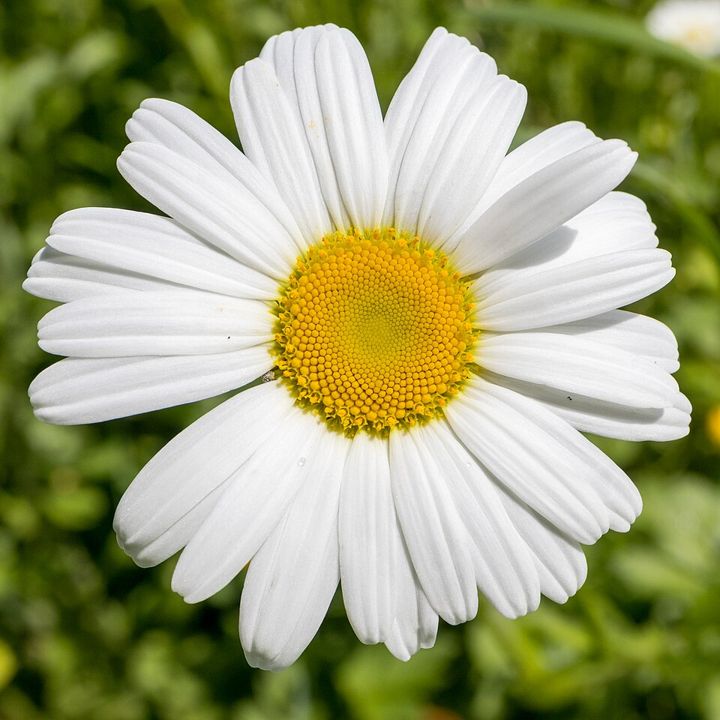
A rhizomatous perennial 30–70 cm tall. Many large serrated leaves on winged stalks round the base of the stem, smaller lance-shaped leaves alternate along it. A large usually solitary head over 8 cm across with twenty to thirty white rays round a dense yellow disc. A small ribbed achene without a pappus. The garden Shasta daisy is mostly the hybrid Leucanthemum × superbum raised from this species, with larger flowers.
Habitat
Borders, roadsides and grassland, hardy; escaped outside its range.
Distribution
Native to France and Spain, growing wild elsewhere as an introduced species and garden escape; common in borders in northern and eastern China, in beds and along roads in Japan (shasuta-dējī), absent from Singapore.
Season and behaviour
May to July, early summer; a flower lasts two weeks.
Photography tips
These are the FilmAnalysis editors' notes, not content from the sources.
A big daisy of white rays and yellow disc: straight down is the classic, a stop under to keep the texture of the rays; side backlight for light through the white petals. Massed, go wide and low so the flowers stand against the sky. Macro on the small yellow florets at the edge of the disc. Bees and hoverflies visit.
Photographic styles
White flowers against the sky; backlit white petals.
Similar species
Oxeye daisy, Leucanthemum vulgare (smaller, more often escaped); common daisy (ground-hugging, small); Mauranthemum paludosum (annual, short).
Related badge
None yet. No validated photo recognition exists for this species, so no badge is tied to it: a name in the encyclopedia is not evidence in a photograph.
The illustration is original FilmAnalysis artwork. The photograph is from Wikimedia Commons; its licence and author are under it.
Why it is listed: this species comes from the Flower checklist (GBIF backbone and Wikidata verified). Names follow the GBIF backbone and Wikidata; the facts follow the sources below; photo recognition is not offered.