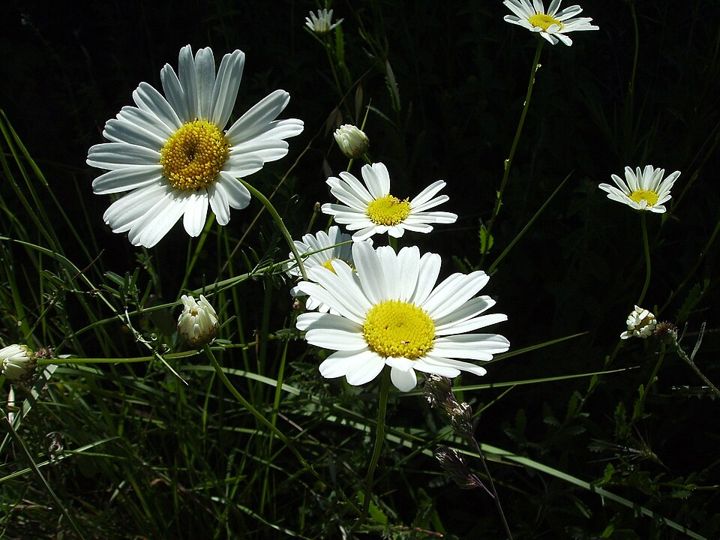
Photo: Victor M. Vicente Selvas, via Wikimedia Commons, public domain / CC0. Unmodified apart from resizing.
Colour
white, yellow
Region
Japan and temperate East Asia
Season
spring, summer
Shape
single flower
Identification
A perennial herb to 80 cm with a creeping underground rhizome. The lower stem hairy, mostly unbranched. The largest leaves are basal, 4–15 cm long and about 5 cm wide, stalked, obovate to spoon-shaped with up to fifteen teeth or lobes; the stem leaves shrink upward, the upper ones stalkless and deeply toothed. Up to three heads per plant, 2–7.5 cm wide, with fifteen to forty white rays 1–2 cm long round yellow disc florets; hairless bracts 7–10 mm. The French marguerite.
Habitat
Grassland, roadsides, field banks, railway sides and waste ground, naturalised and often in sheets in Japan and North America; the flower of the he-loves-me petal game.
Distribution
Native to Europe and temperate Asia and introduced to North America, Australia and New Zealand; naturalised throughout Japan after introduction in the Meiji era, common on early-summer river banks and pastures (furansu-giku); in north-east China and Xinjiang, grown everywhere. Absent from Singapore.
Season and behaviour
May to July, May and June in Japan; a meadow flowers for a month.
Photography tips
These are the FilmAnalysis editors' notes, not content from the sources.
White rays and a yellow eye are the standard daisy graphic, straight down; half a stop under for white and keep the yellow from clipping. A field against the light becomes points of white, compressed with a long lens or wide and low with the sky. Stems sway in a breeze, so 1/640 s.
Photographic styles
Crowds of white daisies in a meadow; the head-on yellow-eye graphic.
Similar species
Shasta daisy (cultivated, larger); English daisy, Bellis (low, all leaves basal, early spring); marguerite, Argyranthemum (shrubby, pinnately cut leaves).
Related badge
None yet. No validated photo recognition exists for this species, so no badge is tied to it: a name in the encyclopedia is not evidence in a photograph.
The illustration is original FilmAnalysis artwork. The photograph is from Wikimedia Commons; its licence and author are under it.
Why it is listed: this species comes from the Flower checklist (GBIF backbone and Wikidata verified). Names follow the GBIF backbone and Wikidata; the facts follow the sources below; photo recognition is not offered.