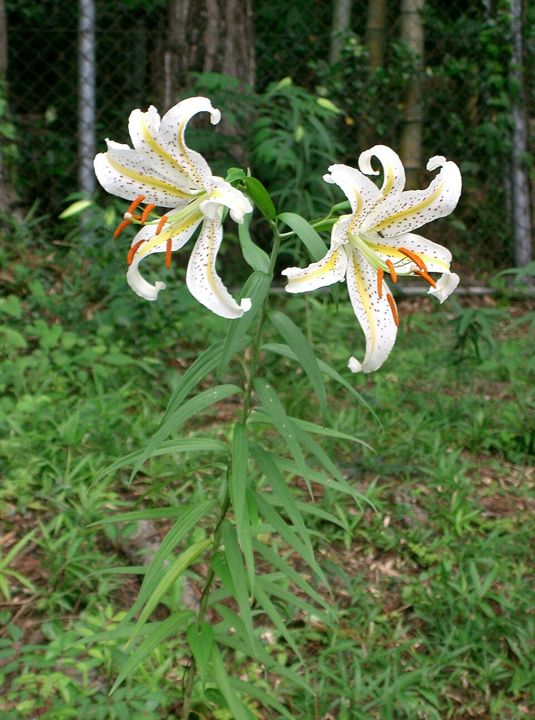
A lily endemic to Japan, yamayuri or mountain lily. The largest flowers of any lily species, up to 25 cm across, white with a golden radial band down the centre of each tepal and scattered crimson spots (the variety platyphyllum has the gold band but no spots), heavily scented. Plants reach 2.5 m and a large stem can carry twenty flowers, bending under their weight. A parent of many modern Oriental hybrid lilies.
Habitat
Grassy hill slopes, forest edge and roadsides up to 1,500 m, in half shade and well-drained soil.
Distribution
Endemic to Japan, mainly Honshu (Kantō, Chūbu, Kinki) and also Shikoku; the hills of Kantō and the Hakone and Tanzawa ranges are famous for it, and it is Kanagawa's prefectural flower. In China and Singapore only as a cut flower and a hybrid parent.
Season and behaviour
July and August, high summer; mid to late July in Kantō; a flower lasts about a week, scent strongest at dusk.
Photography tips
These are the FilmAnalysis editors' notes, not content from the sources.
A huge white flower with gold bands and red spots: a head-on macro for the radiating tepals, in soft light, half a stop to a stop under for white. A stem bent by its flowers beside a hill path is its own pose, from low with a long lens. The scent is overwhelming, so photograph someone bending to it. The deep orange pollen stains.
Photographic styles
Huge white lilies bending by a hill path; macro of gold bands and red spots.
Similar species
Lilium speciosum (recurved pink spotted tepals, south-western Japan); Oriental hybrid lilies (cut flowers, this species among the parents); Easter lily (trumpet, pure white, unspotted).
Related badge
None yet. No validated photo recognition exists for this species, so no badge is tied to it: a name in the encyclopedia is not evidence in a photograph.
The illustration is original FilmAnalysis artwork. The photograph is from Wikimedia Commons; its licence and author are under it.
Why it is listed: this species comes from the Flower checklist (GBIF backbone and Wikidata verified). Names follow the GBIF backbone and Wikidata; the facts follow the sources below; photo recognition is not offered.