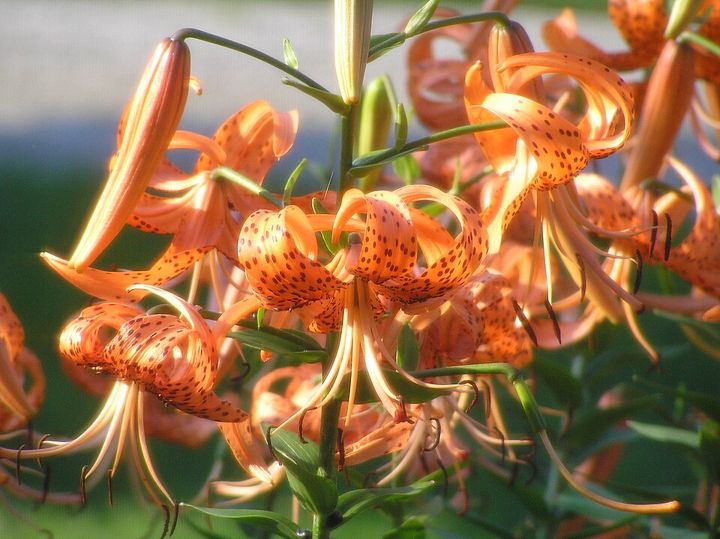
A true lily with upright stems 80–200 cm tall and lanceolate leaves 6–10 cm long. Orange flowers spotted black, the tepals strongly recurved into the ball shape the Chinese name describes, with long projecting stamens and dark brown anthers; odourless, each lasting a few days. Black bulbils in the leaf axils, unusual among lilies, drop and grow into clones of the parent. The bulb is an important food and medicine, ranked with the Lanzhou and Longya lilies.
Habitat
Hill grassland, forest edge, roadsides and valleys, widely grown in gardens and vegetable plots for its edible bulb; a garden escape in eastern North America.
Distribution
Native to China (Jiangsu, Zhejiang, Anhui, Jiangxi, Hunan, Hubei, Guangxi, Sichuan, Tibet, Gansu, Shaanxi, Shanxi, Henan, Hebei, Beijing, Shandong, Jilin and elsewhere), Korea, Japan and the Russian Far East; common in the hills across China and throughout Japan (oniyuri). Absent from Singapore.
Season and behaviour
July and August, in high summer; flowers open in succession on one plant for two or three weeks. Bulbils ripen in August and September.
Photography tips
These are the FilmAnalysis editors' notes, not content from the sources.
The recurved tepals and projecting stamens suit a side or upward view with the flower hanging before a dark background; orange is truest under cloud and bleeds in sun, so a stop under. Macro for the spots; the anthers smear pollen on lenses and clothes, so keep a little distance with a long lens. The black bulbils in the axils are a detail subject.
Photographic styles
Hanging recurved orange flowers; macro of black spots and long stamens.
Similar species
Lilium pumilum (smaller, no bulbils, few spots); daylily (not a lily, tepals not recurved, basal leaves); Lilium henryi (smaller flowers, whorled leaves).
Related badge
None yet. No validated photo recognition exists for this species, so no badge is tied to it: a name in the encyclopedia is not evidence in a photograph.
The illustration is original FilmAnalysis artwork. The photograph is from Wikimedia Commons; its licence and author are under it.
Why it is listed: this species comes from the Flower checklist (GBIF backbone and Wikidata verified). Names follow the GBIF backbone and Wikidata; the facts follow the sources below; photo recognition is not offered.