Japan and temperate East Asia, Singapore and tropical Asia
Season
spring, summer
Shape
trumpet
Identification
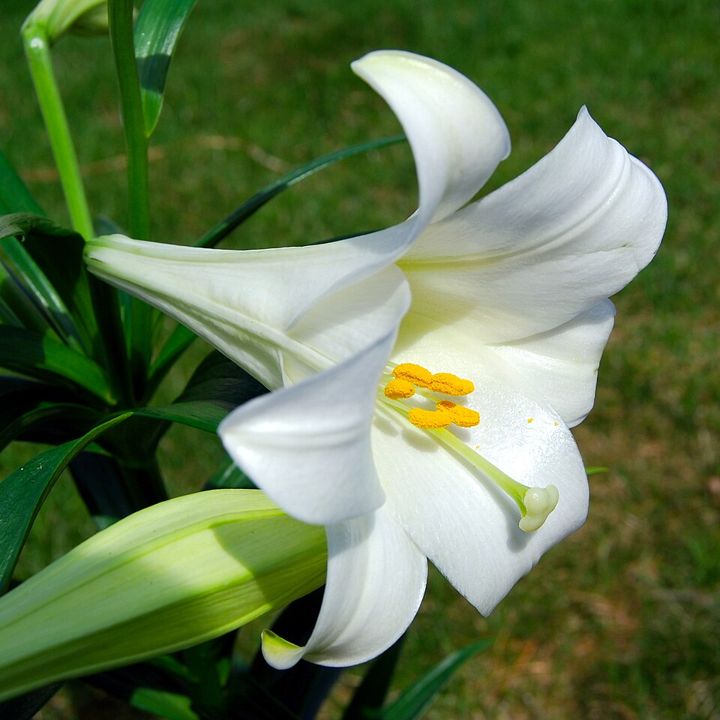
A stem-rooting lily up to 1 m tall. Lanceolate dark green leaves scattered along the stem. Several trumpet-shaped pure white flowers 15–18 cm long held outward, strongly fragrant, with yellow anthers; called teppō-yuri (musket lily) in Japanese for the shape, and Easter lily for its forcing season. The Taiwan lily (L. formosanum) was once treated as a variety of it. Highly toxic to cats.
Habitat
Coastal cliffs, grassy slopes and coral limestone, tolerant of salt spray; grown in huge numbers worldwide as a cut and pot flower.
Distribution
Endemic to Taiwan and the Ryukyu Islands and widely cultivated; Ie Island in the Ryukyus holds a lily festival, it grows wild on Taiwan's north coast, and it is a cut flower in China and Singapore.
Season and behaviour
Flowers in the wild in the Ryukyus and Taiwan from April to June, with the Ie Island festival in late April; cut flowers all year.
Photography tips
These are the FilmAnalysis editors' notes, not content from the sources.
White trumpets want soft light, half a stop to a stop under, head-on for the depth of the trumpet and yellow anthers, side-on for the curve; the pollen stains petals and clothes, so do not touch. Wild lilies on a sea cliff with blue sea are the Ryukyu classic. Indoors, cut stems in window light as still life.
Photographic styles
White trumpets on a sea cliff; cut-flower still life in window light.
Similar species
Taiwan lily (purple-red stripes outside the tepals, taller); Lilium brownii (purple flush outside); musk lily is one of this species' Chinese names.
Related badge
None yet. No validated photo recognition exists for this species, so no badge is tied to it: a name in the encyclopedia is not evidence in a photograph.
The illustration is original FilmAnalysis artwork. The photograph is from Wikimedia Commons; its licence and author are under it.
Why it is listed: this species comes from the Flower checklist (GBIF backbone and Wikidata verified). Names follow the GBIF backbone and Wikidata; the facts follow the sources below; photo recognition is not offered.