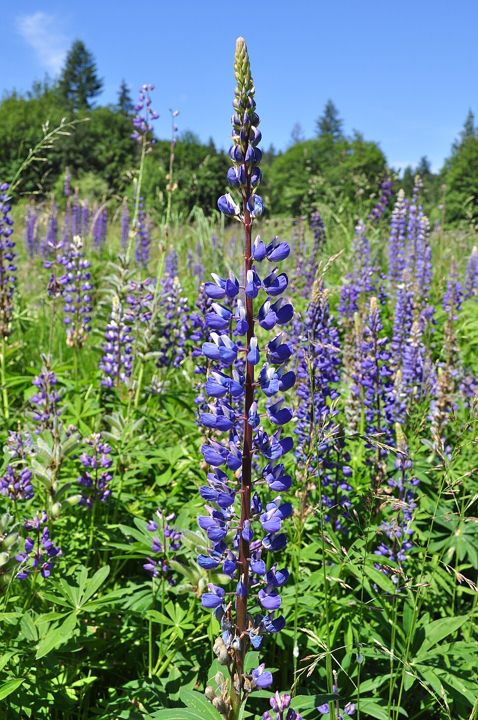
Photo: Joe Mabel (on Flickr as Joe Mabel from Seattle, US), via Wikimedia Commons, licensed CC BY-SA 3.0. Unmodified apart from resizing.
Colour
blue, purple, pink, white, yellow
Region
Japan and temperate East Asia
Season
spring, summer
Shape
spike
IUCN status
Least Concern
Identification
A perennial with stout upright branching stems in clumps up to 1.5 m. Palmately compound leaves of nine to seventeen leaflets 3–15 cm long, like open hands. Flowers packed on a tall raceme, each 1–1.5 cm and pea-shaped, blue to purple in the wild and pink, white, yellow, red and bicoloured in the garden hybrids of which this species is the main parent. Mostly pollinated by bumblebees. It dislikes rich heavy soil, the crown rotting on contact with manure. Invasive in New Zealand and Europe.
Habitat
Streamsides and moist meadows, liking cool weather; temperate borders and highland flower fields, escaped in cool regions.
Distribution
Native to western North America from southern Alaska and British Columbia to Utah and California; grown in borders in northern and highland China (Beijing, Xinjiang, Yunnan), common in the flower fields of Hokkaido and the Japanese highlands (rupinasu, as at Furano), absent from Singapore.
Season and behaviour
May to July, June in Hokkaido; a spike opens from the bottom over two or three weeks.
Photography tips
These are the FilmAnalysis editors' notes, not content from the sources.
Tall coloured spikes want a portrait frame, from low so they stand against the sky; a field compresses into bands of colour with a long lens, and lupins before Hokkaido's hills are the classic. Macro for one pea flower and for the dew drop that gathers at the centre of the palmate leaf. Bumblebees visit, 1/1600 s. Blue-violet is truest under cloud.
Photographic styles
Spikes against the sky; a dew drop at the centre of a palmate leaf.
Similar species
Other lupins (mostly shorter annuals); delphinium (spurred flowers, palmately lobed not compound leaves); foxglove (nodding bells).
Related badge
None yet. No validated photo recognition exists for this species, so no badge is tied to it: a name in the encyclopedia is not evidence in a photograph.
The illustration is original FilmAnalysis artwork. The photograph is from Wikimedia Commons; its licence and author are under it.
Why it is listed: this species comes from the Flower checklist (GBIF backbone and Wikidata verified). Names follow the GBIF backbone and Wikidata; the facts follow the sources below; photo recognition is not offered.