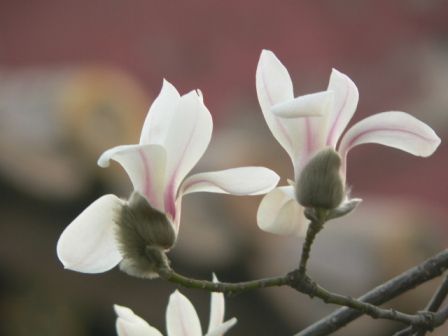
A rather low, rounded, thickly branched, coarse-textured tree to about 9 m. Ovate bright green leaves 15 cm long and 8 cm wide; coarse dark grey bark. White flowers 10–16 cm across of nine thick jade-like tepals held upright like cups, with a citrus-lemon fragrance, opening before the leaves in early spring so the whole tree looks carved from white jade; prone to browning in frost. Grown in Buddhist temple gardens since AD 600, a symbol of purity in the Tang dynasty and planted in the emperor's palace grounds. The city flower of Shanghai and of Daejeon in Korea. In Chinese the white champaca (Michelia) is also called yulan, though it is a different genus.
Habitat
Broadleaf forest in the central mountains, widely planted in gardens, temples, parks and streets; sun-loving and hardy.
Distribution
Native to central and eastern China and widely grown everywhere, the famous early-spring flower of the north; commonly grown in Japan (hakumokuren), absent from Singapore.
Season and behaviour
March, before the leaves and before the cherries; about ten days, cut short by wind and late frost.
Photography tips
These are the FilmAnalysis editors' notes, not content from the sources.
Thick jade-white flowers are cleanest against blue sky, front-lit at plus half a stop so the white keeps its depth without blocking; against the light the tepals show their texture. The tree is tall, so a long lens from below for one or two flowers, or eye level from a high place for the whole tree. A grey sky robs the white of its outline, so then shoot close-ups against dark branches.
Photographic styles
Jade-white flowers against blue sky; single-flower close-ups against dark wood.
Similar species
Lily magnolia (purple-red, a shrub, flowers with leaves); saucer magnolia (a hybrid, purple outside and white within); white champaca, Michelia × alba (evergreen, small narrow intensely fragrant flowers, southern China).
Related badge
The album badge "a magnolia" unlocks when the vision model explicitly names a a magnolia in your photo and you rate the analysis. The badge stops at "a magnolia": it does not tell species apart, and this page existing unlocks nothing.
The illustration is original FilmAnalysis artwork. The photograph is from Wikimedia Commons; its licence and author are under it.
Why it is listed: this species comes from the Flower checklist (GBIF backbone and Wikidata verified). Names follow the GBIF backbone and Wikidata; the facts follow the sources below; photo recognition is not offered.