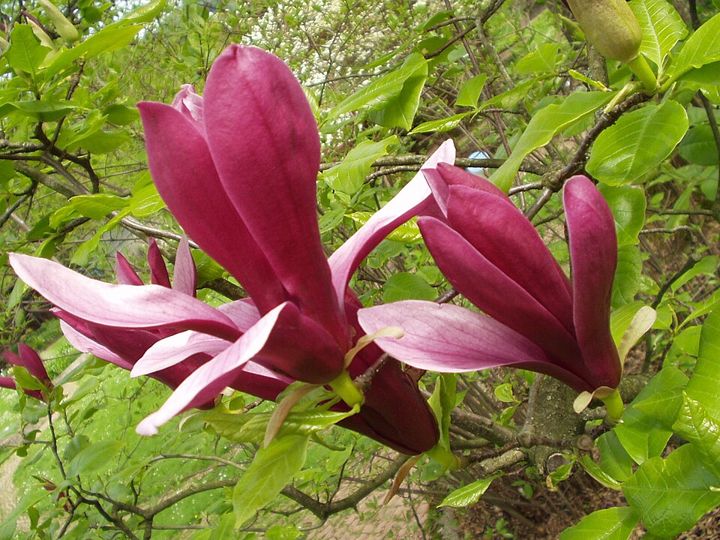
A deciduous shrub or small tree, often multi-stemmed, about 3 m tall. Elliptic-obovate leaves unfolding with or just after the flowers. Flowers upright like lilies or tulips, purple-red outside and pale purple to near white within, with nine tepals, the outer three small and sepal-like; the bud shaped like a writing brush, hence the Chinese name wooden brush; lightly scented, a Tang poem calling it purple bracts with red flame, scented like lotus and orchid. The dried buds are the medicinal xinyi. Endemic to China, paired with the Yulan magnolia and grown for two thousand years.
Habitat
Forest edge on hillsides at 300–1,600 m, widely planted in gardens, temples and streets.
Distribution
Native to southern China (Yunnan, Fujian, Hubei, Sichuan and elsewhere) and grown everywhere; cultivated in Japan since early times (mokuren, shimokuren), from where it reached English-speaking countries and was misnamed Japanese magnolia. Absent from Singapore.
Season and behaviour
Late March to April, about two weeks after the Yulan magnolia, with the leaves; about ten days, with a few flowers again in summer.
Photography tips
These are the FilmAnalysis editors' notes, not content from the sources.
Tepals purple outside and white within have most depth against the light, half a stop under; the upright flower suits an eye-level or slightly upward view against blue sky or dark trunk. The brush-shaped bud is a subject in itself, side-lit for its down. Framed with a Yulan magnolia it shows the colour difference.
Photographic styles
Purple-red tepals against the light; close-ups of brush-shaped buds.
Similar species
Yulan magnolia (white, a tree, before the leaves, two weeks earlier); saucer magnolia (its hybrid with the Yulan, purple outside and white within, larger, a tree); Magnolia biondii (small flowers before the leaves, northern).
Related badge
The album badge "a magnolia" unlocks when the vision model explicitly names a a magnolia in your photo and you rate the analysis. The badge stops at "a magnolia": it does not tell species apart, and this page existing unlocks nothing.
The illustration is original FilmAnalysis artwork. The photograph is from Wikimedia Commons; its licence and author are under it.
Why it is listed: this species comes from the Flower checklist (GBIF backbone and Wikidata verified). Names follow the GBIF backbone and Wikidata; the facts follow the sources below; photo recognition is not offered.