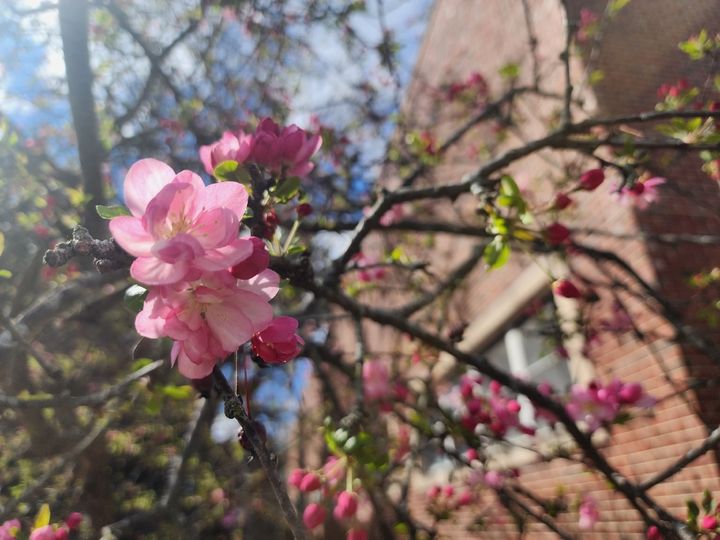
Photo: Kaden Slone, via iNaturalist, licensed CC BY 4.0. Unmodified apart from resizing.
Colour
pink
Region
Japan and temperate East Asia
Season
spring
Shape
cluster
IUCN status
Data Deficient
Identification
A tree to 5 m with spreading branches. Pink flowers on long slender purple drooping stalks so that each flower hangs as if on a thread, hence the Chinese name hanging-thread crabapple; small purple fruit. Often mistaken for cherry, but told by the purple-red (not green) pedicels, the un-notched petals half-open into a cup, and flowering with the leaves. Also called Fujian hill cherry. Endemic to China, though some hold it native to Japan.
Habitat
Open woodland on hillsides and by streams, and more often in gardens, temples and parks, also in pots; a classic flower of Chinese tradition alongside the Xifu crabapple.
Distribution
Endemic to China, wild in Jiangsu, Zhejiang, Anhui, Shaanxi, Sichuan and Yunnan; widely planted in gardens everywhere, and grown in Japan (hanakaidō, introduced in the Edo period, frequent in Kyoto temples). Absent from Singapore.
Season and behaviour
Late March to mid-April with the cherries, about a week; small fruit in autumn.
Photography tips
These are the FilmAnalysis editors' notes, not content from the sources.
Hanging flowers want an upward view, pink against the sky, with the slender purple pedicels in the frame as the best distinction from cherry; pink is truest in soft light. The half-open cup has more of the crabapple character than a fully open flower, in side macro. Red temple walls and black tiles are the traditional backdrop.
Photographic styles
Pink flowers hanging on threads; spring before a temple's red wall.
None yet. No validated photo recognition exists for this species, so no badge is tied to it: a name in the encyclopedia is not evidence in a photograph.
The illustration is original FilmAnalysis artwork. The photograph is from iNaturalist; its licence and author are under it.
Why it is listed: this species comes from the Flower checklist (GBIF backbone and Wikidata verified). Names follow the GBIF backbone and Wikidata; the facts follow the sources below; photo recognition is not offered.