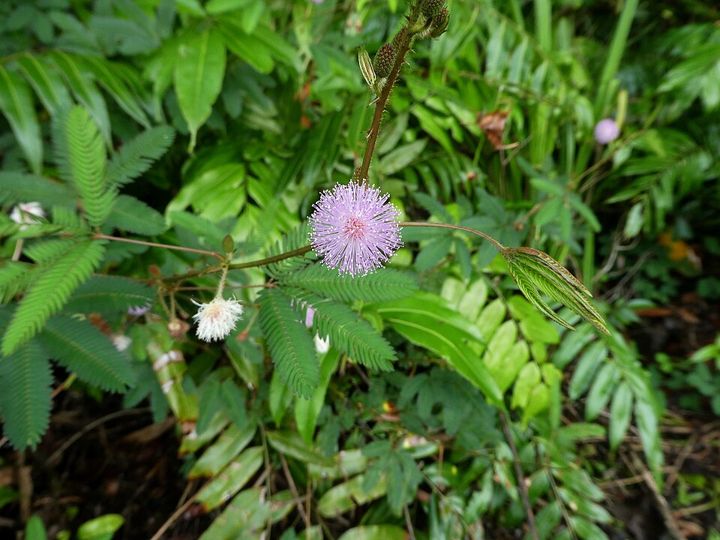
A creeping or trailing annual or perennial, erect when young, with slender branched prickly stems up to 1.5 m long and an upright height of about 30 cm. Bipinnate leaves of one or two pairs of pinnae with 10–26 leaflets each, on prickly petioles; touched or shaken they fold inward and droop at once, reopening a few minutes later, the classic example of rapid plant movement and the source of its names. Pale pink or purple globular flower heads 8–10 mm across from the leaf axils, the petals red above and the filaments pink on close inspection; each flower lives less than a day.
Habitat
Roadsides, grass, waste ground and plantation edges, tenacious and treated as a weed in many countries.
Distribution
Native to tropical America (Brazil), now throughout the tropics. Very common on lawns and roadsides in Singapore, naturalised in southern China, Taiwan and Okinawa.
Season and behaviour
Flowers all year in the tropics, June to September in China; freshest in the morning, while the folding leaves can be watched all day.
Photography tips
These are the FilmAnalysis editors' notes, not content from the sources.
The pink pompon needs a macro in soft light, since front light fuses the filaments into a blob and side backlight gives them translucency. The folding leaves can be shot as a burst sequence or short video; do not keep touching the same plant, which tires. A dark green background.
Photographic styles
Macro of pink pompons; sequences of folding leaves.
Similar species
Mimosa bimucronata (shrubby, hairless); Mimosa diplotricha (larger, more prickly); other pink pompon legumes (silk tree flowers are much larger).
Related badge
None yet. No validated photo recognition exists for this species, so no badge is tied to it: a name in the encyclopedia is not evidence in a photograph.
The illustration is original FilmAnalysis artwork. The photograph is from Wikimedia Commons; its licence and author are under it.
Why it is listed: this species comes from the Flower checklist (GBIF backbone and Wikidata verified). Names follow the GBIF backbone and Wikidata; the facts follow the sources below; photo recognition is not offered.