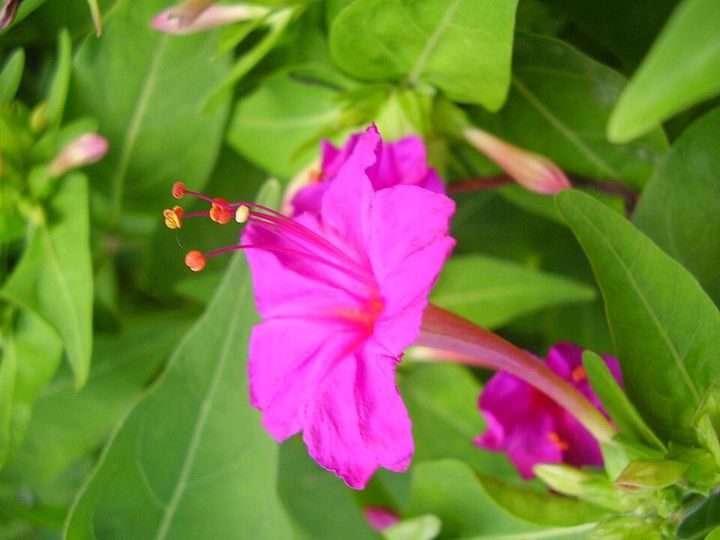
Photo: Khalid Mahmood at English Wikipedia, via Wikimedia Commons, public domain / CC0. Unmodified apart from resizing.
Colour
pink, yellow, white, red
Region
Japan and temperate East Asia, Singapore and tropical Asia
Season
summer, autumn
Shape
single flower
Identification
A bushy perennial herb mostly about 1 m tall, grown as an annual in temperate zones. Thick, four-angled, much-branched stems rooting at the nodes and often sprawling. Funnel-shaped flowers open from late afternoon to dusk, between four and eight o'clock, hence the English name; flowers of different colours grow on one plant and a single flower can be splashed with sectors, flakes and spots, the plain colours yellow, red, magenta, pink or white. The spherical wrinkled fruit turns black when ripe, like a little land mine, the source of its Chinese nickname.
Habitat
Gardens, roadsides, wall bases and waste ground, self-seeding freely; one of the commonest dooryard flowers of Chinese towns and villages, and believed to have been grown by the Aztecs.
Distribution
Native to tropical America, Jalapa being the capital of Veracruz in Mexico; now throughout the warm world. Commonly grown and escaped across China, in Japan and in Singapore.
Season and behaviour
June to October, opening each evening and closing the next morning, also open by day in rain and cloud. Photograph it at dusk or dawn.
Photography tips
These are the FilmAnalysis editors' notes, not content from the sources.
It opens at dusk, right in the blue hour: add a touch of warm light from a small source, or use a tripod for a long exposure in the twilight. The many colours and splashed flowers on one plant are the subject, with head-on macro for the variegated petals. Dewy flowers still open at dawn work too.
Photographic styles
Splashed flowers opening at dusk; a yard in twilight.
Similar species
Other Mirabilis species (rarely grown); morning glory (a vine that opens at dawn and closes by evening, the reverse).
Related badge
None yet. No validated photo recognition exists for this species, so no badge is tied to it: a name in the encyclopedia is not evidence in a photograph.
The illustration is original FilmAnalysis artwork. The photograph is from Wikimedia Commons; its licence and author are under it.
Why it is listed: this species comes from the Flower checklist (GBIF backbone and Wikidata verified). Names follow the GBIF backbone and Wikidata; the facts follow the sources below; photo recognition is not offered.