Singapore and tropical Asia, Japan and temperate East Asia
Season
summer, autumn
Shape
cluster
Identification
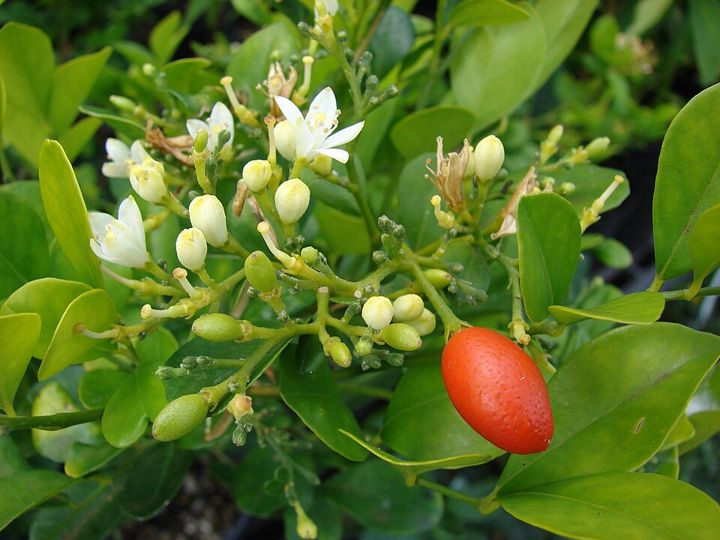
A shrub or small tree to 7 m that often flowers and fruits as a shrub, with smooth pale to whitish bark. Pinnate leaves up to 17 cm long with up to seven glossy egg-shaped to elliptical leaflets. Fragrant white or cream flowers with five (sometimes four) petals 13–18 mm long in loose groups, so scented that the Chinese names say the perfume carries seven or nine li; the fruit an oval orange-red berry 12–14 mm long.
Habitat
An understorey shrub of rainforest, and everywhere as hedging and bonsai; on streets, in parks and housing estates across Singapore and southern China.
Distribution
Native to South Asia, South-East Asia and Australia; widely planted in southern China and Taiwan, one of Singapore's commonest hedge plants, and grown in Okinawa.
Season and behaviour
Flowers on and off all year in the tropics, in flushes after rain and briefly each time; April to September in southern China. The scent is strongest at dusk and at night.
Photography tips
These are the FilmAnalysis editors' notes, not content from the sources.
Clusters of white among glossy dark leaves are cleanest in soft light, half a stop under for the white. Orange-red fruit and white flowers often share a bush, two colours in one frame. After rain at dawn the flowers are freshest and beaded with water: macro for the five petals and long filaments.
Photographic styles
White clusters among dark green leaves; the everyday hedge.
Similar species
Arabian jasmine (simple leaves, larger rounder flowers); citrus blossom (winged petioles); other Murraya species.
Related badge
None yet. No validated photo recognition exists for this species, so no badge is tied to it: a name in the encyclopedia is not evidence in a photograph.
The illustration is original FilmAnalysis artwork. The photograph is from Wikimedia Commons; its licence and author are under it.
Why it is listed: this species comes from the Flower checklist (GBIF backbone and Wikidata verified). Names follow the GBIF backbone and Wikidata; the facts follow the sources below; photo recognition is not offered.