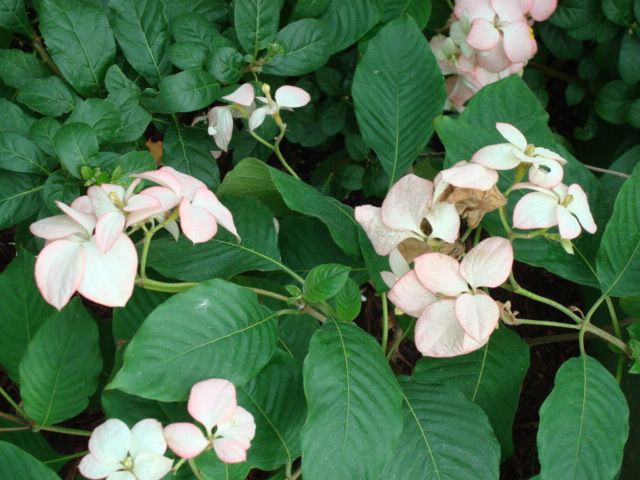
A shrub or small tree native to the Philippines. The true flowers are small, yellow and tubular and inconspicuous; the show is a calyx lobe (all of them in cultivars) enlarged into a leaf-like white or pink sepal, like paper fans or sheets of paper, the Chinese names; clusters drape the branches so that from afar the plant looks hung with coloured paper. Philippine cultivars are named after first ladies: Doña Aurora (white), Doña Luz (pink), Doña Alicia (dark pink), Queen Sirikit (light pink) and Doña Eva (dark red), among the commonest ornamental shrubs of South-East Asia.
Habitat
Tropical roadsides, parks and gardens in sun and heat; lowland forest edge at home.
Distribution
Native to the Philippines (Agboy in Aklan) and widely grown as an ornamental across South-East Asia; very common on Singapore's roadsides and in its parks (the pink forms above all), grown in southern China (Guangdong, Hainan, Yunnan), glasshouse-only in Japan.
Season and behaviour
All year in the tropics, most after the rains; the leafy sepals last weeks.
Photography tips
These are the FilmAnalysis editors' notes, not content from the sources.
The leafy sepals are thin and translucent, so backlight is the light: a whole cluster lit through like paper. Pink forms are truest in soft light, half a stop under for white. Macro to find the small yellow flower hidden among the sepals, which is the real flower. The whole shrub at eye level for the massed fans, dark green leaves behind.
Photographic styles
Translucent paper fans against the light; the small yellow flower among the sepals.
Similar species
Red flag bush, Mussaenda erythrophylla (scarlet sepals); Mussaenda pubescens (wild in China, one small white sepal); bougainvillea (bracts rather than sepals, thorny).
Related badge
None yet. No validated photo recognition exists for this species, so no badge is tied to it: a name in the encyclopedia is not evidence in a photograph.
The illustration is original FilmAnalysis artwork. The photograph is from Wikimedia Commons; its licence and author are under it.
Why it is listed: this species comes from the Flower checklist (GBIF backbone and Wikidata verified). Names follow the GBIF backbone and Wikidata; the facts follow the sources below; photo recognition is not offered.