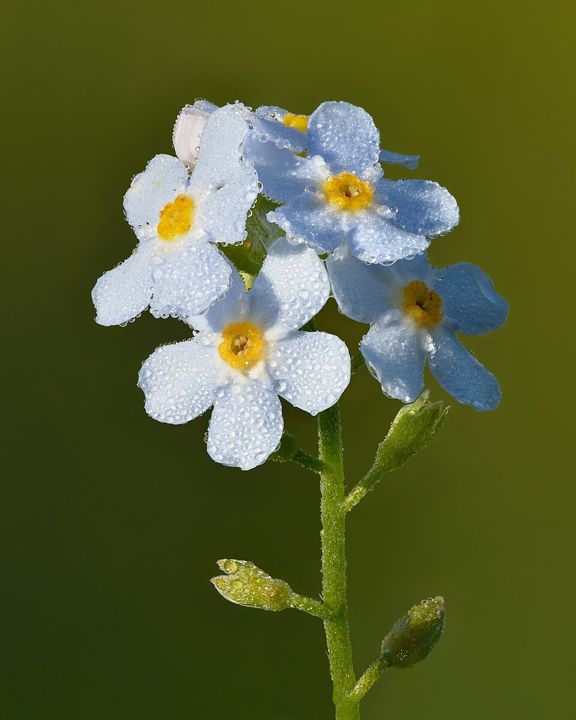
An erect to ascending perennial up to 70 cm. Oblong to linear leaves hairy on both sides. Small flowers 8–12 mm, pink in bud and sky blue when open, with yellow centres and white honey guides, in scorpioid cymes (the epithet means scorpion-like). The long style separates it from its relatives. It favours wet ground, survives submerged and often forms floating rafts. The true forget-me-not.
Habitat
Bogs, pond margins, streams, ditches and river banks, in shallow water or wet grassland; also grown as a waterside flower in East Asia.
Distribution
Native to Europe and Asia (western, central and northern), naturalised in North America and elsewhere; in Xinjiang and north-east China, naturalised and grown in wetlands from Honshu northwards in Japan (wasurenagusa, common by water in Hokkaido and Nagano), absent from Singapore.
Season and behaviour
May to July, April to June in Japan, June to August in the north; on until the first frost.
Photography tips
These are the FilmAnalysis editors' notes, not content from the sources.
A centimetre-wide flower leaves macro as the only option, head-on for the sky blue against the yellow eye; pink buds and blue flowers on one cyme are its small colour scale. Low at the water's edge so the flowers float before dark water. Blue is truest under cloud. Massed, a long lens turns them into blue mist.
Photographic styles
Blue mist by the water; macro of pink buds and blue flowers.
Similar species
Wood forget-me-not, Myosotis sylvatica (woodland, the common bedding forget-me-not, short style); Trigonotis (smaller white-blue flowers); borage (large nodding stars).
Related badge
None yet. No validated photo recognition exists for this species, so no badge is tied to it: a name in the encyclopedia is not evidence in a photograph.
The illustration is original FilmAnalysis artwork. The photograph is from Wikimedia Commons; its licence and author are under it.
Why it is listed: this species comes from the Flower checklist (GBIF backbone and Wikidata verified). Names follow the GBIF backbone and Wikidata; the facts follow the sources below; photo recognition is not offered.