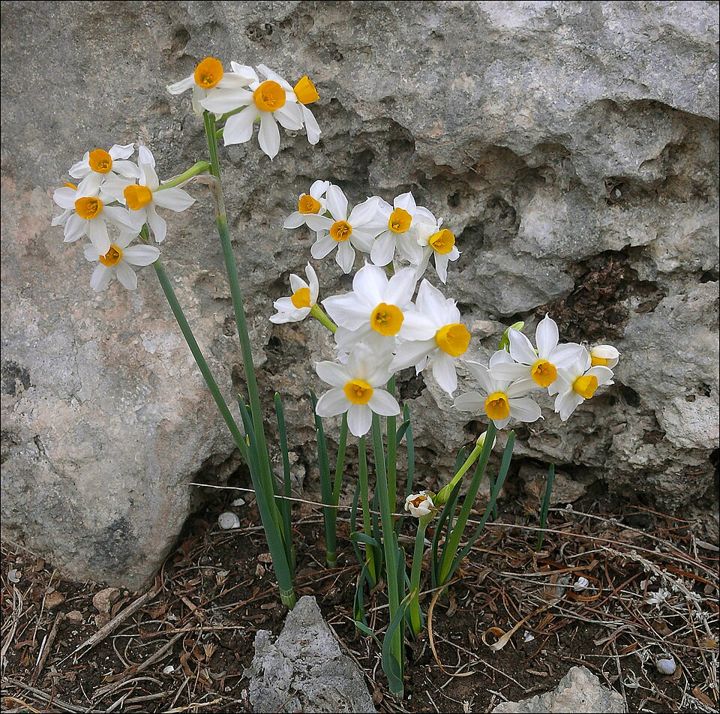
A bulb and one of the tallest narcissi, up to 80 cm; thin flat strap leaves up to 40 cm long and 1.5 cm wide. Umbels of up to eight flowers, white tepals round a yellow cup-shaped corona (gold cup on a silver stand in Chinese), intensely fragrant, with a scent compound found in only a few other plants such as roses. The Chinese narcissus (var. chinensis) is a variety grown in water and carved for the Spring Festival, called the Chinese sacred lily in the West. The whole plant is poisonous.
Habitat
Damp coastal sand, river banks and field edges, widely grown in beds and forced indoors; Zhangzhou in Fujian is the source of the bulbs.
Distribution
Native to the Mediterranean from Portugal to Turkey and naturalised in the Middle East, Central and South Asia, the Canaries, China (Fujian, Zhejiang), Japan and Australia; large naturalised colonies on Japan's coasts (Echizen, Awaji, Bōsō) are a famous winter flower; China is known for the Zhangzhou narcissus; scarce in Singapore.
Season and behaviour
December to March, December and January on the Echizen coast; indoor narcissus around the Spring Festival is a Chinese New Year custom.
Photography tips
These are the FilmAnalysis editors' notes, not content from the sources.
White tepals round a yellow cup read clearest in soft light, with a head-on macro for the cup; half a stop under for white. Japan's coastal colonies with sea and cliffs are a winter sight, wide and low. Narcissus grown in water in a celadon bowl is a traditional still life in window light. The scent is strong, so photograph someone smelling it.
Photographic styles
White narcissus on a coastal cliff; a water-grown still life.
Similar species
Wild daffodil, Narcissus pseudonarcissus (large solitary flowers with a long trumpet corona); poet's narcissus (white, Europe); the Chinese narcissus is a variety of this species.
Related badge
None yet. No validated photo recognition exists for this species, so no badge is tied to it: a name in the encyclopedia is not evidence in a photograph.
The illustration is original FilmAnalysis artwork. The photograph is from Wikimedia Commons; its licence and author are under it.
Why it is listed: this species comes from the Flower checklist (GBIF backbone and Wikidata verified). Names follow the GBIF backbone and Wikidata; the facts follow the sources below; photo recognition is not offered.