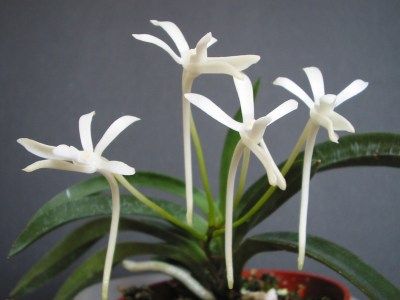
A small epiphytic orchid 8–12 cm tall on a monopodial stem of 1–6 cm. Four to twenty narrowly oblong sickle-curved leaves (the epithet means sickle-shaped), 5–12 cm, leathery and sheathed at the base, in two ranks like a fan. A suberect inflorescence 5–8 cm with two to ten small white flowers, intensely fragrant (more so at night), each with a long curved spur, like a white bird. Many whitish aerial roots from the base. Hundreds of cultivars selected since Edo-period Japan for leaf variegation, flower colour and form are called fūkiran, a classic of Japanese traditional horticulture; modern taxonomy places it in Vanda (Vanda falcata).
Habitat
On the branches and trunks of deciduous and evergreen trees, occasionally on cliffs and stone walls, in good air movement; a traditional pot plant in Japan and China on antique pots with sphagnum.
Distribution
China (central, southern and south-western), Korea and Japan (Honshu west of Kantō, Shikoku, Kyushu, the Ryukyus); Japan is the centre of cultivation and cultivars, it grows wild in Zhejiang, Fujian and Hubei and is potted there, scarce in the wild through collecting, absent from Singapore.
Season and behaviour
June and July at the end of the rainy season; one flowering lasts two or three weeks and the scent rises at dusk.
Photography tips
These are the FilmAnalysis editors' notes, not content from the sources.
Small white flowers with long spurs are the subject: from the side or slightly below for the curve of the spur, a dark background to float the white, half a stop to a stop under. The fan of two-ranked leaves and the white aerial roots are the fūkiran points, so frame the whole plant from above. A traditional pot and stand in window light as still life; leaf variegation needs side light. The scent is nocturnal, so try a night shot under one lamp.
Photographic styles
White birds with long spurs; a fūkiran still life on an antique pot.
Similar species
Other Vanda (far larger); Dendrobium (pseudobulbs, larger flowers); the wind orchid's own cultivars (different variegation and colours).
Related badge
None yet. No validated photo recognition exists for this species, so no badge is tied to it: a name in the encyclopedia is not evidence in a photograph.
The illustration is original FilmAnalysis artwork. The photograph is from Wikimedia Commons; its licence and author are under it.
Why it is listed: this species comes from the Flower checklist (GBIF backbone and Wikidata verified). Names follow the GBIF backbone and Wikidata; the facts follow the sources below; photo recognition is not offered.