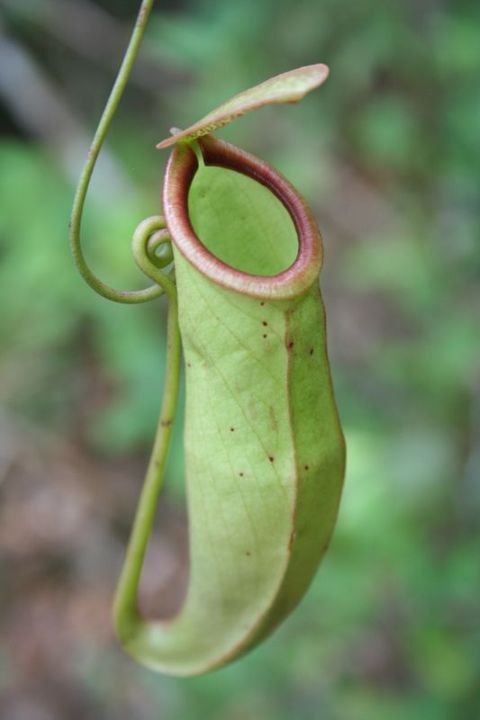
By far the most widespread Nepenthes. A climbing or sprawling herb whose leaf tips extend as tendrils into pitchers: green to red-brown, with a ribbed peristome at the mouth and a lid against rain; lower pitchers squat, upper ones slender. Small flowers in racemes, dioecious and inconspicuous, so as a flower it is a marvel of leaf rather than bloom. The epithet means wonderful. Extremely variable, the best-known variety being the toothed-mouthed form of Brunei and Sarawak.
Habitat
Swamps, wet grassland, damp road banks and secondary forest edge on poor acid soil in sun; it supplements nitrogen by trapping insects.
Distribution
From southern China (Guangdong, Hainan, Hong Kong, Macau) through Indochina and all the major islands of the Malay Archipelago (except the Lesser Sundas and northern Philippines) to New Guinea and Australia's Cape York; occasional on wetland and roadside in Singapore, wild populations in Hong Kong and Hainan, absent from Japan.
Season and behaviour
Pitchers all year in the tropics, fullest in the rains; flowers from April to November and not the point.
Photography tips
These are the FilmAnalysis editors' notes, not content from the sources.
The pitcher is the subject: against the light it turns translucent and shows the fluid level and insects inside, the most interesting picture; side light for the ribbed mouth and lid. Macro with a small aperture, since a pitcher has depth. Lower pitchers on the ground need you lying down. A protected wild plant: never pick or transplant it.
Photographic styles
Translucent pitchers against the light; a marvel at the swamp edge.
Similar species
Other Nepenthes (different pitcher shapes, peristomes and lids, mostly highland species); pitcher plants, Sarracenia (North America, upright rolled leaves, another family).
Related badge
None yet. No validated photo recognition exists for this species, so no badge is tied to it: a name in the encyclopedia is not evidence in a photograph.
The illustration is original FilmAnalysis artwork. The photograph is from Wikimedia Commons; its licence and author are under it.
Why it is listed: this species comes from the Flower checklist (GBIF backbone and Wikidata verified). Names follow the GBIF backbone and Wikidata; the facts follow the sources below; photo recognition is not offered.