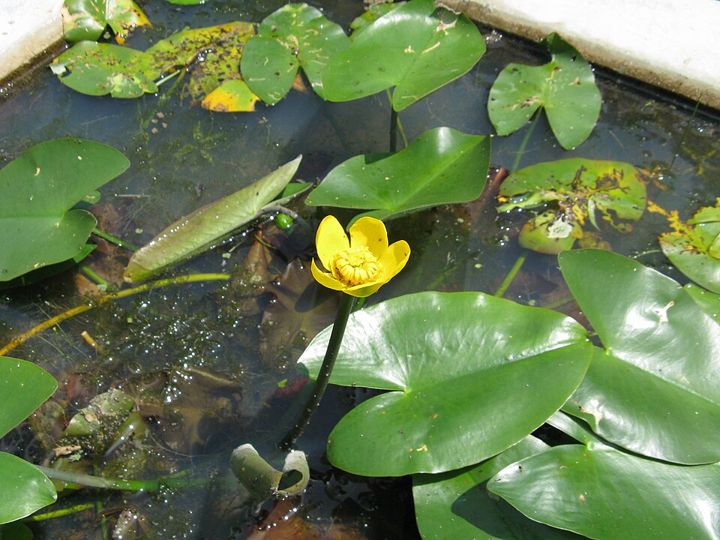
A rhizomatous aquatic perennial. Two kinds of leaf: thin wavy submerged leaves and long-ovate floating or emergent leaves with arrow-shaped bases, dark green. Solitary yellow flowers held above the water, 4–5 cm across; what look like petals are five thick yellow sepals, the true petals small and many inside, with numerous stamens and a disc-shaped stigma. The Japanese name kōhone, river bone, refers to the white bone-like rhizome. Fruit ripens at the surface. The Saijo Basin in Hiroshima holds three Nuphar species in one place.
Habitat
Lakes, ponds and slow streams, rooted in mud with emergent leaves; paddy ditches and wetland parks throughout Japan.
Distribution
Native to Japan, Korea and the Russian Far East; common in the ponds of Honshu, Shikoku and Kyushu and a representative summer wetland flower. China's relative is Nuphar pumila; this species is grown there only in botanic gardens. Absent from Singapore.
Season and behaviour
June to September, high summer; a flower lasts days and opens by day.
Photography tips
These are the FilmAnalysis editors' notes, not content from the sources.
A yellow cup a few centimetres above the water: from low on the bank with a long lens so it floats before dark water, half a stop under for yellow. The thick sepals are glossy, so side light for their texture; from above for the disc stigma and small inner petals. Dragonflies perch on the flowers and emergent leaves, a summer pairing.
Photographic styles
Yellow cups above the water; dragonflies and emergent leaves.
None yet. No validated photo recognition exists for this species, so no badge is tied to it: a name in the encyclopedia is not evidence in a photograph.
The illustration is original FilmAnalysis artwork. The photograph is from Wikimedia Commons; its licence and author are under it.
Why it is listed: this species comes from the Flower checklist (GBIF backbone and Wikidata verified). Names follow the GBIF backbone and Wikidata; the facts follow the sources below; photo recognition is not offered.