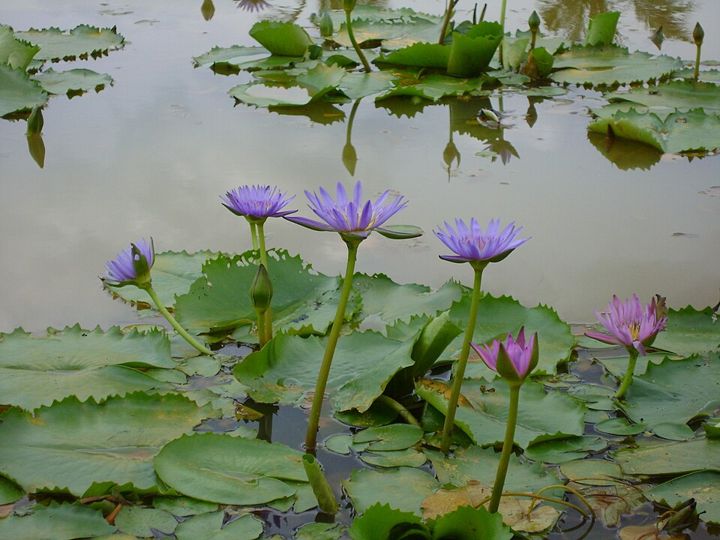
A day-blooming aquatic with submerged roots and stems, some leaves submerged and others just above the surface. Round leaves green above and often dark below, the floating ones with undulating crenellated edges, 20–23 cm across, a plant spreading 1.5 m. Flowers usually white or blue, also violet, pink and cream, with four or five sepals and 13–15 angular petals that make a star from above, hence star lotus; the cup 4–15 cm across. The blue lotus of Buddhist scripture (utpala in Sanskrit) and the national flower of Bangladesh and Sri Lanka. The Egyptian blue lotus is usually treated as a variety of it.
Habitat
Ponds, lakes, paddies and slow channels in shallow water; widely grown in the pools of tropical parks and temple water jars.
Distribution
Native to southern and eastern Asia from Afghanistan, the Indian subcontinent and Sri Lanka through South-East Asia to southern China, Taiwan and northern Australia; common in Singapore's pools and wetlands, wild and cultivated in southern China (Guangdong, Hainan, Yunnan, Taiwan), glasshouse-only in Japan.
Season and behaviour
All year in the tropics, most in the rains, June to October in southern China. Open by day, fullest in the morning, closing at dusk, each flower lasting three or four days.
Photography tips
These are the FilmAnalysis editors' notes, not content from the sources.
The star shows only from above, where the angular petals read; pale blue bleaches under noon light, so nine or ten in the morning with side light is best, half a stop under. Low at water level the flower floats between crenellated leaves and reflections. Blue is truest under cloud. A single blue lotus in a temple water jar is a ready still life.
Photographic styles
A star-shaped blue flower from above; one blue lotus in a water jar.
Similar species
Egyptian blue lotus, Nymphaea caerulea (often a variety of this species); pygmy water lily, Nymphaea tetragona (small, white, temperate); tropical water lily hybrids (more colours); lotus (leaves and flowers held high above the water).
Related badge
The album badge "a water lily" unlocks when the vision model explicitly names a a water lily in your photo and you rate the analysis. The badge stops at "a water lily": it does not tell species apart, and this page existing unlocks nothing.
The illustration is original FilmAnalysis artwork. The photograph is from Wikimedia Commons; its licence and author are under it.
Why it is listed: this species comes from the Flower checklist (GBIF backbone and Wikidata verified). Names follow the GBIF backbone and Wikidata; the facts follow the sources below; photo recognition is not offered.