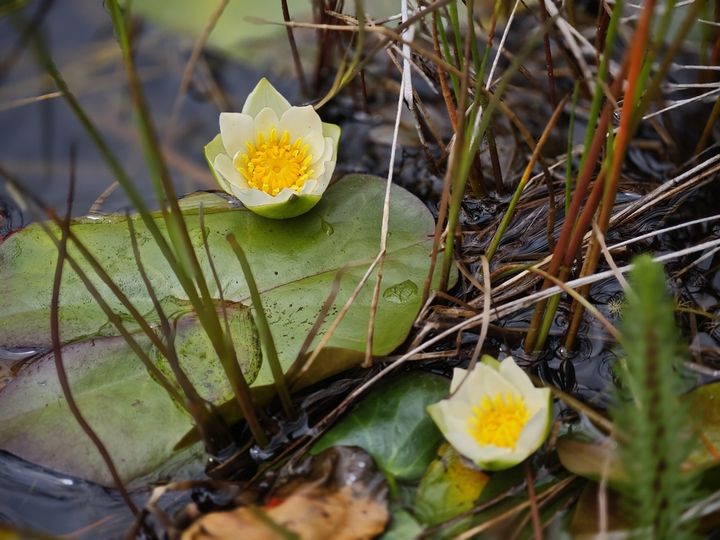
Photo: tuirnee, via iNaturalist, public domain / CC0. Unmodified apart from resizing.
Colour
white, yellow
Region
Japan and temperate East Asia
Season
summer, autumn
Shape
single flower
IUCN status
Least Concern
Identification
An aquatic perennial with a rhizome in the mud and heart-shaped floating leaves. Small white flowers with 8–15 petals and dense yellow stamens, the four sepals forming a square at the base (the epithet means four-angled); opening in the afternoon and closing by evening, hence the Chinese name noon lotus. One of the smallest and hardiest water lilies and a parent of many hardy garden forms.
Habitat
Ponds, lakes and quiet streams in water 1–2 m deep, with wild rice, arrowhead and bulrushes.
Distribution
Very wide: from northern Europe to Korea and the Himalayas, most of China, Japan, India, Kashmir, Kazakhstan, Russia and Vietnam, and the boreal regions of North America and Europe above 50°N. Wild in ponds across China and throughout Japan (hitsujigusa). Absent from Singapore.
Season and behaviour
June to September, opening each afternoon and closing by evening for three or four days; the Japanese name refers to the hour of the sheep, around two in the afternoon.
Photography tips
These are the FilmAnalysis editors' notes, not content from the sources.
It opens only in the afternoon, when the light is harder: a polariser kills the surface glare so dark water sets off the white flower, half a stop under. A low viewpoint at water level for flower and reflection, or straight down for the geometry of heart-shaped leaf and flower. The half-closed state before evening is good too.
Photographic styles
Small white flowers on dark water; reflections under a polariser.
Similar species
Garden water lilies (large, many colours); European white water lily (much larger); lotus (leaves held above the water).
Related badge
The album badge "a water lily" unlocks when the vision model explicitly names a a water lily in your photo and you rate the analysis. The badge stops at "a water lily": it does not tell species apart, and this page existing unlocks nothing.
The illustration is original FilmAnalysis artwork. The photograph is from iNaturalist; its licence and author are under it.
Why it is listed: this species comes from the Flower checklist (GBIF backbone and Wikidata verified). Names follow the GBIF backbone and Wikidata; the facts follow the sources below; photo recognition is not offered.