Singapore and tropical Asia, Japan and temperate East Asia
Season
summer, autumn
Shape
single flower
IUCN status
Least Concern
Identification
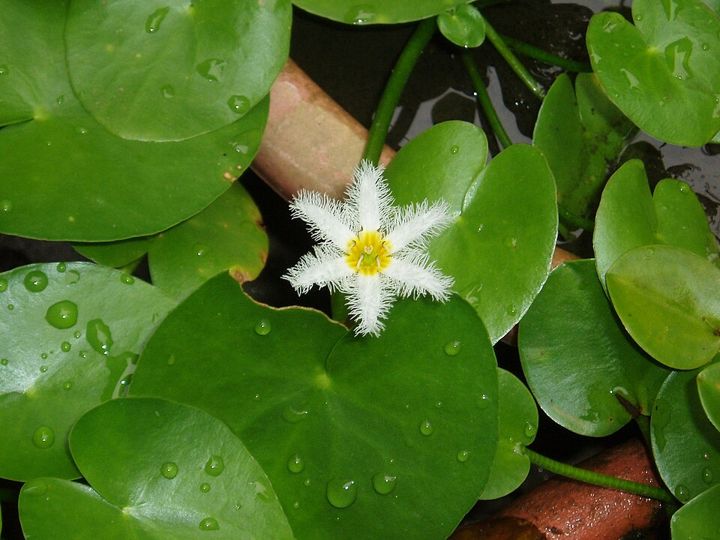
A floating-leaved aquatic rooted in pond mud with leaves on the surface like small water lilies, spreading by rhizomes into clusters. Small white flowers about 1 cm across in clusters at the base of the leaf stalk, with five petals (sometimes more) densely fringed with white hairs round a yellow centre, like snowflakes floating on the water, hence the English name. Called one-leaf lotus in Japanese.
Habitat
Still or slow water of ponds, lakes, marshes and paddies, also grown as a water-garden plant; a minor escaped weed in Florida.
Distribution
Native to tropical areas around the world; wild in ponds of southern China and Taiwan, present from Honshu south in Japan and in Singapore's ponds and wetlands.
Season and behaviour
June to October, the flowers opening in the morning and closing by evening, each for a single day; densest in late summer.
Photography tips
These are the FilmAnalysis editors' notes, not content from the sources.
The fringed petals are the whole point: macro straight down, with backlight making the white hairs glow at half a stop under. The flower sits on the water, so a polariser kills the surface glare and lets the green of the floating leaves be the background; water drops caught in the fringe after rain are best of all.
Photographic styles
White snowflakes on water; macro of fringed petals.
Similar species
Fringed water lily, Nymphoides peltata (yellow, larger); the Chinese name gold-and-silver lotus is also used for this species; water lilies are far larger.
Related badge
None yet. No validated photo recognition exists for this species, so no badge is tied to it: a name in the encyclopedia is not evidence in a photograph.
The illustration is original FilmAnalysis artwork. The photograph is from Wikimedia Commons; its licence and author are under it.
Why it is listed: this species comes from the Flower checklist (GBIF backbone and Wikidata verified). Names follow the GBIF backbone and Wikidata; the facts follow the sources below; photo recognition is not offered.