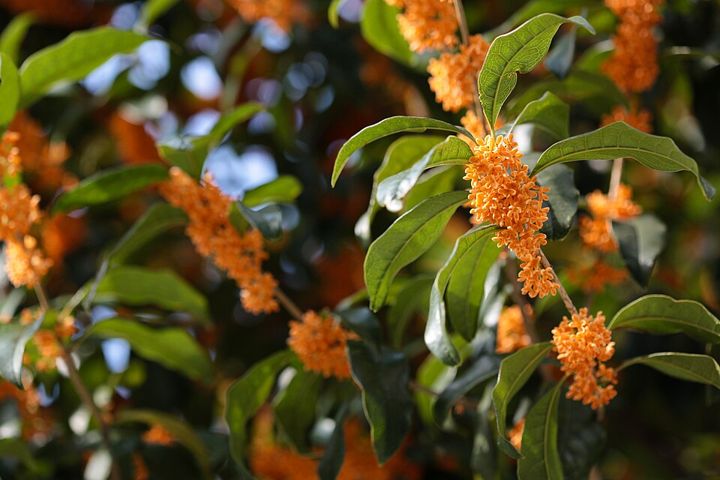
An evergreen shrub or small tree. Opposite elliptic to oblong leathery leaves, smooth above with toothed edges. Flowers in autumn, tiny, clustered in the leaf axils, the corolla four-lobed almost to the base, cream-white (silver osmanthus, the type), yellow (gold) or orange-red (dan gui), so fragrant that one tree scents a whole street. Purple-black drupes. The flowers go into sugar, wine and cakes.
Habitat
Gardens, temples, parks, streets and hill forest edge, one of the commonest garden trees of southern China; the city flower of Hangzhou, Suzhou and Guilin.
Distribution
Native to China (Guizhou, Sichuan, Hainan, Yunnan and elsewhere), the Himalayas, Assam, Myanmar, Thailand, Cambodia, Vietnam, Taiwan and Japan; planted everywhere south of the Yangtze, common from Honshu south in Japan (the orange form is ubiquitous as kinmokusei), scarce in Singapore.
Season and behaviour
September and October, peaking around the Mid-Autumn Festival for a week to ten days, sometimes with a second winter flush; the scent sits heaviest in the dew of early morning.
Photography tips
These are the FilmAnalysis editors' notes, not content from the sources.
The flowers are too small and dense for a single bloom to mean anything: take a length of branch packed with clusters, side-backlit so the little flowers glow, against the shade of dark leaves, half a stop under. A layer of fallen flowers on the ground, stone steps or water is the other picture. Osmanthus is really a flower of smell, and a person in the frame, smelling or gathering it, carries that.
Photographic styles
Fine gold among dark green leaves; stone steps strewn with fallen flowers.
Similar species
Gold and orange osmanthus are cultivar groups of this species; holly osmanthus (spiny leaves, white winter flowers); glossy privet (white summer flowers in big panicles).
Related badge
None yet. No validated photo recognition exists for this species, so no badge is tied to it: a name in the encyclopedia is not evidence in a photograph.
The illustration is original FilmAnalysis artwork. The photograph is from Wikimedia Commons; its licence and author are under it.
Why it is listed: this species comes from the Flower checklist (GBIF backbone and Wikidata verified). Names follow the GBIF backbone and Wikidata; the facts follow the sources below; photo recognition is not offered.