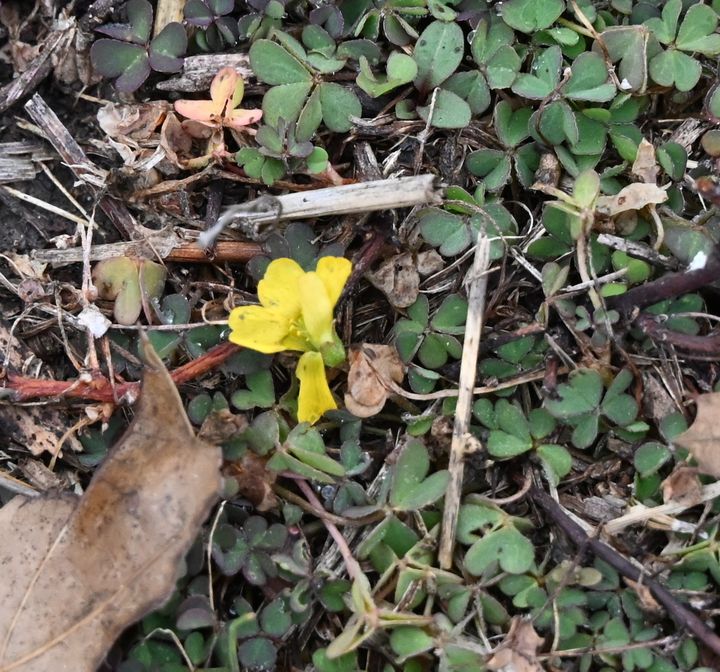
Photo: Vince Hale, via iNaturalist, public domain / CC0. Unmodified apart from resizing.
Colour
yellow
Region
Japan and temperate East Asia, Singapore and tropical Asia
Season
spring, summer, autumn
Shape
single flower
Identification
A delicate low creeping herb with slender stems rooting at the nodes. Trifoliate leaves of three rounded heart-shaped leaflets like a clover; some forms green-leaved, others purple (var. atropurpurea). Small yellow five-petalled flowers with round or pointed petals that close when out of direct sun, hence the name sleeping beauty; one to over twenty per plant. The fruit is a narrow cylindrical capsule 1–2 cm long that fires its seeds explosively.
Habitat
Roadsides, lawns, flower pots, wall cracks and field banks, favouring moist climates; a worldwide weed and one of the commonest city wildflowers.
Distribution
Probably native to South-East Asia, described by Linnaeus in 1753; now across the temperate and tropical world. Very common throughout China, Japan and Singapore.
Season and behaviour
Flowers almost all year in warm regions, mainly March to October in the Yangtze basin and Japan; the flowers open only in sun and close on dull mornings.
Photography tips
These are the FilmAnalysis editors' notes, not content from the sources.
The flower is a centimetre across, so a macro or long-lens macro at ground level is essential. It opens only in sun, yet direct light clips the yellow: shade it with something translucent or wait for thin cloud. The dark leaves of the purple form are a ready background for the yellow; the seed capsule bursting takes high-speed bursts and patience.
Photographic styles
Macro of small yellow flowers; the everyday of roadside weeds.
Similar species
Common yellow woodsorrel, Oxalis stricta (upright stems that do not root at the nodes); pink woodsorrel (larger pink flowers).
Related badge
None yet. No validated photo recognition exists for this species, so no badge is tied to it: a name in the encyclopedia is not evidence in a photograph.
The illustration is original FilmAnalysis artwork. The photograph is from iNaturalist; its licence and author are under it.
Why it is listed: this species comes from the Flower checklist (GBIF backbone and Wikidata verified). Names follow the GBIF backbone and Wikidata; the facts follow the sources below; photo recognition is not offered.