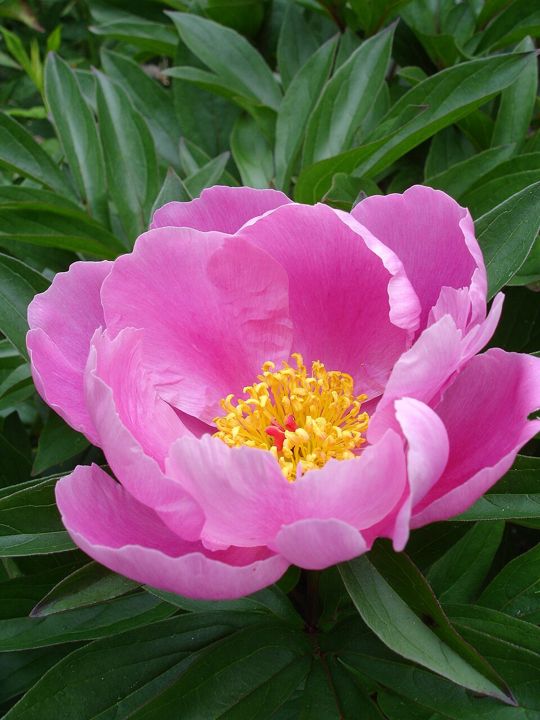
A herbaceous perennial 50–70 cm tall and wide with twice-ternate nine-lobed leaves 20–40 cm long. Large round buds appear in late spring (May in the northern hemisphere) and open into fragrant cup- or bowl-shaped flowers 8–16 cm across with 5–10 white, pink or crimson petals and yellow stamens; the many double cultivars are the mainstay of the cut-flower trade. The epithet means milk-white-flowered. Anciently the flower of parting and of love in China, paired with the tree peony as the two wonders among flowers; the root is the medicinal bai shao.
Habitat
Dry open stony slopes, river banks and sparse woodland edges; widely grown in gardens, parks and flower farms (Heze, Bozhou, Hangzhou), and attractive to butterflies.
Distribution
Native to central and eastern Asia from eastern Tibet across northern China to eastern Siberia; wild in north-east, northern and north-west China and widely cultivated everywhere; commonly grown in Japan (shakuyaku, the flower a beauty is said to stand like), absent from Singapore.
Season and behaviour
May and June, about two weeks after the tree peony, for around ten days; cut flowers from April to June.
Photography tips
These are the FilmAnalysis editors' notes, not content from the sources.
A large flower for a medium lens head-on or at three-quarters, the layers of a double at their finest in soft light; half a stop under for white. Ants on the buds eating the honeydew are its particular small detail. After rain the heavy heads droop, so a low viewpoint; cut peonies in window light as a still life are its indoor tradition.
Photographic styles
Soft-light portraits of big double flowers; still life in window light.
Similar species
Tree peony (a woody shrub with larger flowers, broader leaf lobes, two weeks earlier); Paeonia veitchii (red, more finely cut leaves, south-west).
Related badge
The album badge "a peony" unlocks when the vision model explicitly names a a peony in your photo and you rate the analysis. The badge stops at "a peony": it does not tell species apart, and this page existing unlocks nothing.
The illustration is original FilmAnalysis artwork. The photograph is from Wikimedia Commons; its licence and author are under it.
Why it is listed: this species comes from the Flower checklist (GBIF backbone and Wikidata verified). Names follow the GBIF backbone and Wikidata; the facts follow the sources below; photo recognition is not offered.