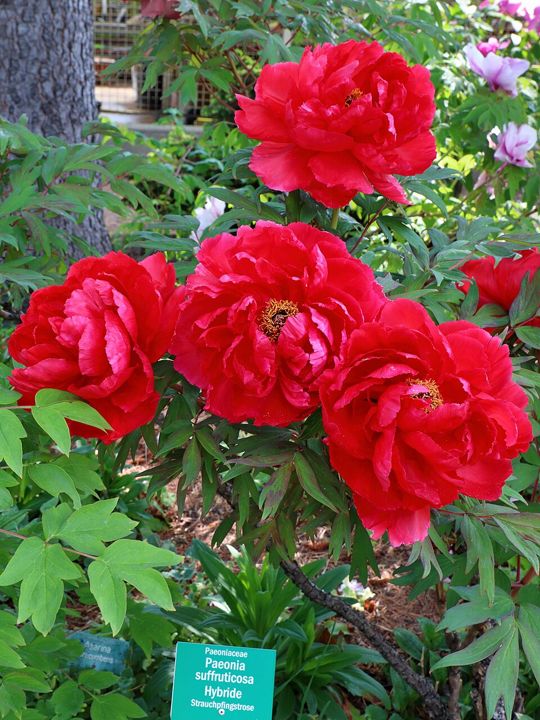
A deciduous small shrub 1–1.5 m tall, a group of hybrid cultivars of Chinese origin whose parents all belong to subsection Vaginatae. Twice-ternate leaves with leaflets usually three- to five-lobed. In early summer (in practice mostly April) solitary, huge, many-layered flowers, white, pink, red, purple, yellow or bicoloured, over 20 cm across, the carpels set on a fleshy disc and densely hairy. First grown for medicine (the root bark mudanpi), soon for ornament, bred for over a thousand years into thousands of cultivars; in the Tang dynasty a whole city went mad in the twenty days it flowered, and it is the king of flowers.
Habitat
Gardens, temples, parks and dedicated peony gardens, in sun, hardy, hating wet ground; Luoyang and Heze have been cultivation centres for a thousand years, and Japan has its peony temples.
Distribution
Originated in China and grown throughout the country, with Luoyang, Heze, Pengzhou and Tongling the famous centres; grown in Japan since the Nara period (botan); absent from Singapore.
Season and behaviour
Mid-April to early May, peaking in Luoyang in mid-April; one flower about a week, the twenty days of the poem being the whole garden's season.
Photography tips
These are the FilmAnalysis editors' notes, not content from the sources.
The huge layered flower wants a medium lens head-on or at three-quarters, the layers given depth only by soft light, since noon sun bleaches the petals; a stop under for red. Dewy flowers at dawn are best, and by noon they droop a little. Peony gardens are crowded, so pick one flower from outside the bed with a long lens and let the rest blur into colour. The traditional gongbi painting composition, flower, leaf and branch each taking a corner, is worth borrowing.
Photographic styles
Soft-light portraits of huge layered flowers; compositions from gongbi painting.
Similar species
Chinese peony (herbaceous, stems dying back each year, slightly smaller, two weeks later); Paeonia rockii (purple blotch at the petal base, north-west); yellow tree peonies, Paeonia lutea and ludlowii (yellow, south-western mountains).
Related badge
The album badge "a peony" unlocks when the vision model explicitly names a a peony in your photo and you rate the analysis. The badge stops at "a peony": it does not tell species apart, and this page existing unlocks nothing.
The illustration is original FilmAnalysis artwork. The photograph is from Wikimedia Commons; its licence and author are under it.
Why it is listed: this species comes from the Flower checklist (GBIF backbone and Wikidata verified). Names follow the GBIF backbone and Wikidata; the facts follow the sources below; photo recognition is not offered.