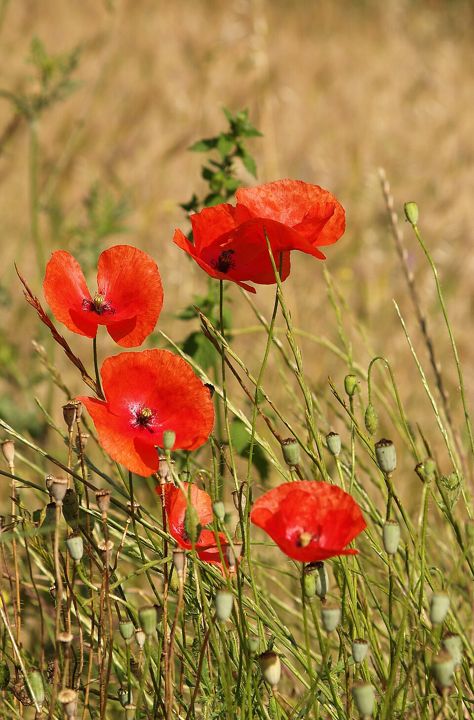
A variable erect annual about 70 cm tall whose seeds persist in the soil for years and germinate whenever it is disturbed. The flower stems carry coarse hairs at right angles (unlike the appressed hairs of the long-headed poppy), one flower per stem, large and showy, 5–10 cm across, with four vivid red petals usually black-blotched at the base and slightly overlapping; cultivars white, pink, purple and double (Shirley poppies). A plant can bear 400 flowers in a season, each lasting a day. Unlike the opium poppy it contains no opiates.
Habitat
Cornfields, roadsides, disturbed ground and flower fields; an agricultural weed in Europe and the remembrance flower since the First World War (the Flanders poppy). Grown in quantity as an ornamental in ancient China.
Distribution
Native to North Africa and temperate Eurasia and introduced to temperate regions on every continent but Antarctica; grown in flower fields and borders across China, common in Japan's spring river-bank flower fields (the Arakawa in Tokyo, Kōnosu in Saitama; hinageshi), absent from Singapore.
Season and behaviour
April to June, May in Japan; each flower a day, a field three or four weeks. Freshly opened petals are still creased in the morning.
Photography tips
These are the FilmAnalysis editors' notes, not content from the sources.
Petals thin as silk are at their best against the light, red glowing and the black blotch a silhouette, a stop under to stop the red bleeding. Newly opened petals in the morning are creased, a texture of their own. A field compresses with a long lens into a density of red dots, or wide and low; a single flower head-on in macro for the blotch and blue-black anthers. In wind, 1/1000 s.
Photographic styles
Red silk petals against the light; red dots in a field.
None yet. No validated photo recognition exists for this species, so no badge is tied to it: a name in the encyclopedia is not evidence in a photograph.
The illustration is original FilmAnalysis artwork. The photograph is from Wikimedia Commons; its licence and author are under it.
Why it is listed: this species comes from the Flower checklist (GBIF backbone and Wikidata verified). Names follow the GBIF backbone and Wikidata; the facts follow the sources below; photo recognition is not offered.