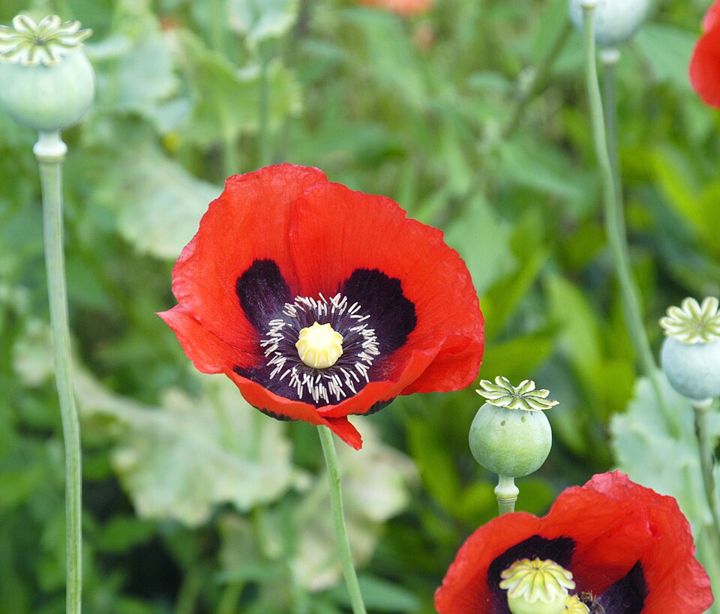
Photo: tanja niggendijker from apeldoorn, the netherlands, via Wikimedia Commons, licensed CC BY 2.0. Unmodified apart from resizing.
Colour
pink, white, purple, red
Region
Japan and temperate East Asia
Season
spring, summer
Shape
single flower
Identification
An annual herb about 100 cm tall, strongly glaucous so the whole plant looks grey-green, with sparse coarse hairs on stem and leaves. Large lobed leaves, the upper ones clasping the stem and the lowest shortly stalked. Flowers 8–18 cm across, normally with four red, white or mauve petals, often with a dark patch at the base; the fruit a hairless rounded capsule topped with 12–18 radiating stigmatic rays. All parts exude white latex when cut. The source of opium and of analgesics such as morphine and codeine, and of poppy seeds as food. In China, Singapore and Japan growing it without a licence is illegal, and it is seen only in licensed medicinal gardens and research institutions.
Habitat
Native to the western Mediterranean, cultivated since antiquity for medicine and ornament and naturalised across the temperate world; in China grown only in licensed botanical gardens and pharmaceutical sites.
Distribution
Probably native to Macaronesia and the western Mediterranean, its origin obscured by millennia of cultivation and introduction; now naturalised in much of the temperate world. Private cultivation is prohibited in China, Japan and Singapore, but botanical gardens (such as the Beijing Medicinal Botanical Garden and the Tokyo Metropolitan Medicinal Plant Garden) display it legally.
Season and behaviour
Flowers in May and June, each for two or three days; display beds in botanical gardens are fenced during flowering.
Photography tips
These are the FilmAnalysis editors' notes, not content from the sources.
Photograph only in a legal botanical display, through the railing with a long lens. The grey-green leaves and large flowers harmonise in soft light; macro for the dark petal blotch and the radiating stigma disc. The geometry of the capsule is fine against the light. Record where the picture was taken and label the plant as controlled.
Photographic styles
Soft tones of grey-green leaves and big flowers; the geometry of a capsule.
Similar species
Corn poppy (smaller vivid red flowers, coarsely hairy, leaves not clasping, legal to grow); oriental poppy (perennial, coarsely hairy leaves); Iceland poppy (low, yellow-orange).
Related badge
None yet. No validated photo recognition exists for this species, so no badge is tied to it: a name in the encyclopedia is not evidence in a photograph.
The illustration is original FilmAnalysis artwork. The photograph is from Wikimedia Commons; its licence and author are under it.
Why it is listed: this species comes from the Flower checklist (GBIF backbone and Wikidata verified). Names follow the GBIF backbone and Wikidata; the facts follow the sources below; photo recognition is not offered.