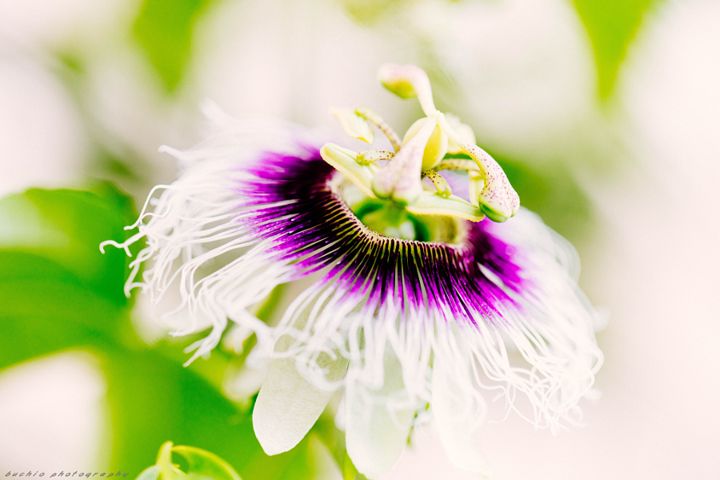
A perennial vine with axillary tendrils, red or purple when young. Two main forms: purple-fruited and yellow-fruited. Usually one flower per node, 5–7.5 cm wide, with five oblong green sepals and five white petals surmounted by a fringe of purple-and-white filaments like the marks on a clock face; a rich purple base, five stamens, an ovary and a branched style whose three stigmas point like clock hands, hence the East Asian name clock fruit. The fruit a round to oval berry, yellow or dark purple when ripe, 4–7.5 cm, filled with seedy juicy pulp.
Habitat
Tropical and subtropical orchards, trellises, fences and home gardens in sun on well-drained soil; widely grown commercially.
Distribution
Native to southern Brazil, Paraguay and northern Argentina and brought to Europe around 1610; now widely grown through the tropics, on a large scale in Guangxi, Yunnan, Fujian and Taiwan, common on garden fences in Singapore, and grown in Okinawa and Kagoshima.
Season and behaviour
Flowers on and off all year in the tropics, May to September in southern China; the flower opens in the morning and closes by afternoon for a single day, so shoot in the morning. Fruit June to November.
Photography tips
These are the FilmAnalysis editors' notes, not content from the sources.
The flower is built like a clock, and straight down is the only angle that catches corona, stamens and stigmas together, with a macro and small aperture for depth; the purple-and-white corona is clearest in soft light. Around ten in the morning it is flattest. Fruit on the vine and a cut cross-section are subjects too.
Photographic styles
A clock-face flower from above; fruit on the vine.
Similar species
Blue passion flower (blue, white and purple corona, the hardy ornamental); egg fruit is another Chinese name for this species; giant granadilla (red flowers, large fruit).
Related badge
None yet. No validated photo recognition exists for this species, so no badge is tied to it: a name in the encyclopedia is not evidence in a photograph.
The illustration is original FilmAnalysis artwork. The photograph is from Wikimedia Commons; its licence and author are under it.
Why it is listed: this species comes from the Flower checklist (GBIF backbone and Wikidata verified). Names follow the GBIF backbone and Wikidata; the facts follow the sources below; photo recognition is not offered.