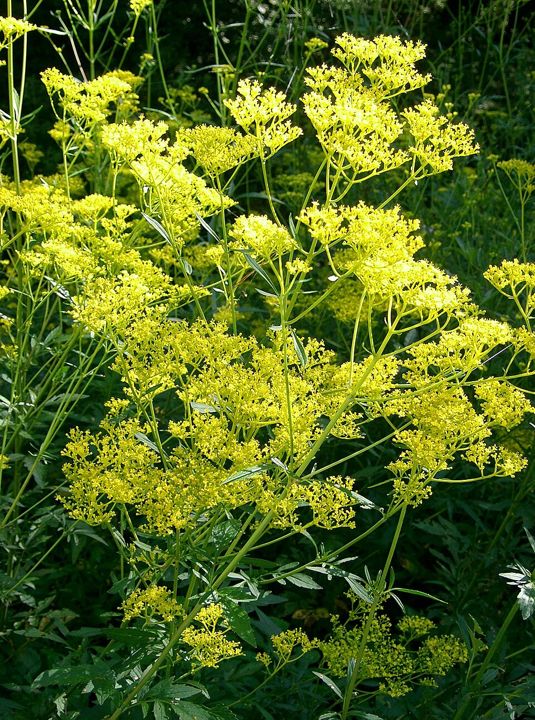
A perennial herb with erect stems to over 1 m, branching above. Opposite leaves deeply pinnately cut into lanceolate, coarsely toothed lobes. Tiny yellow flowers crowded into flat-topped terminal cymes like a layer of golden lace, hence the English name; each flower five-lobed. The whole plant has the peculiar smell of fermented bean paste that gives the Chinese name. The root is medicinal.
Habitat
Hill grassland, forest edge, roadsides and field banks in full sun; as ominaeshi one of Japan's seven autumn herbs, often grown in gardens.
Distribution
Native to south-eastern Siberia, Mongolia, the Russian Far East, most of China, Vietnam, Korea, Japan and the Ryukyus, introduced to Irkutsk; common in the hills across China and throughout Japan. Absent from Singapore.
Season and behaviour
July to October, peaking in August and September, the signature colour of early-autumn meadows in Japan.
Photography tips
These are the FilmAnalysis editors' notes, not content from the sources.
The flat yellow heads look like golden mist against the light, with a dark hillside or shadow behind; a long lens turns the yellow dots of a meadow into a pattern. Macro for the five lobes and projecting stamens of a single floret. The low light of an autumn evening suits its colour best.
Photographic styles
Gold on an early-autumn slope; backlit flat heads.
None yet. No validated photo recognition exists for this species, so no badge is tied to it: a name in the encyclopedia is not evidence in a photograph.
The illustration is original FilmAnalysis artwork. The photograph is from Wikimedia Commons; its licence and author are under it.
Why it is listed: this species comes from the Flower checklist (GBIF backbone and Wikidata verified). Names follow the GBIF backbone and Wikidata; the facts follow the sources below; photo recognition is not offered.