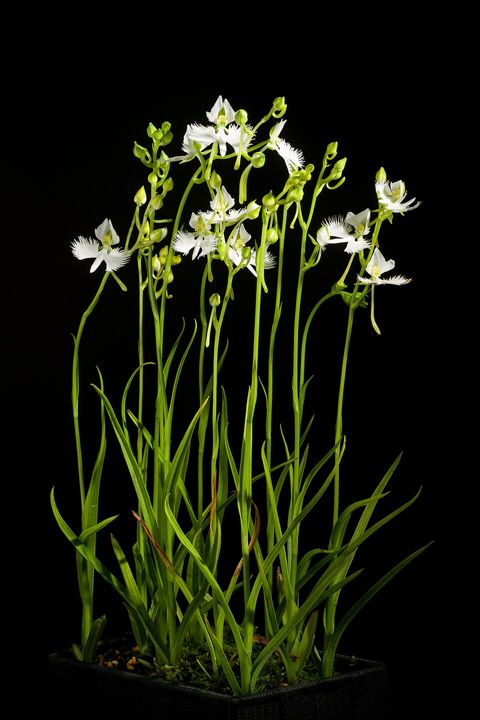
Photo: sunoochi from Sapporo, Hokkaido, Japan, via Wikimedia Commons, licensed CC BY 2.0. Unmodified apart from resizing.
Colour
white
Region
Japan and temperate East Asia
Season
summer
Shape
single flower
Identification
A terrestrial orchid with small tubers and grass-like leaves. Spikes 20–50 cm carry two or three pure white flowers whose three-lobed lip has deeply fringed side lobes, spread like a white egret in flight, hence egret flower and the Japanese sagisō; a long spur. The ward flower of Setagaya in Tokyo, with a legend of a castle princess. Over-collection and the loss of wetlands have cut wild numbers sharply, and it is endangered. Not to be confused with the North American white fringed orchid, Platanthera praeclara.
Habitat
Lowland wet grassland, acid bogs and damp sunny slopes, moist but not waterlogged; a traditional pot plant in Japan grown in sphagnum, the plants sold being cultivated tubers.
Distribution
Japan (Honshu, Shikoku, Kyushu), Korea, China (Taiwan and the east) and the Russian Far East; Japan is the centre of cultivation and appreciation with scattered wild populations, wild plants are rare in China, absent from Singapore.
Season and behaviour
July to September, high summer into early autumn; each flower lasts about a week.
Photography tips
These are the FilmAnalysis editors' notes, not content from the sources.
The egret shape works only head-on at flower level, in macro, with a dark or deep green background and a stop under to hold the detail of the fringe; from the side for the long spur. The flower is 3 cm, so a tripod and a small aperture. Potted egret flowers by a window in soft light look like a flock in flight. An endangered wild orchid: photograph cultivated plants only, do not trample wetlands, never collect.
Photographic styles
A white egret spreading its wings head-on; a flock of white birds before a dark background.
Similar species
Pecteilis susannae (far larger, coarser fringe); Habenaria (greenish-white, different fringe); the North American white fringed orchid (another genus).
Related badge
None yet. No validated photo recognition exists for this species, so no badge is tied to it: a name in the encyclopedia is not evidence in a photograph.
The illustration is original FilmAnalysis artwork. The photograph is from Wikimedia Commons; its licence and author are under it.
Why it is listed: this species comes from the Flower checklist (GBIF backbone and Wikidata verified). Names follow the GBIF backbone and Wikidata; the facts follow the sources below; photo recognition is not offered.