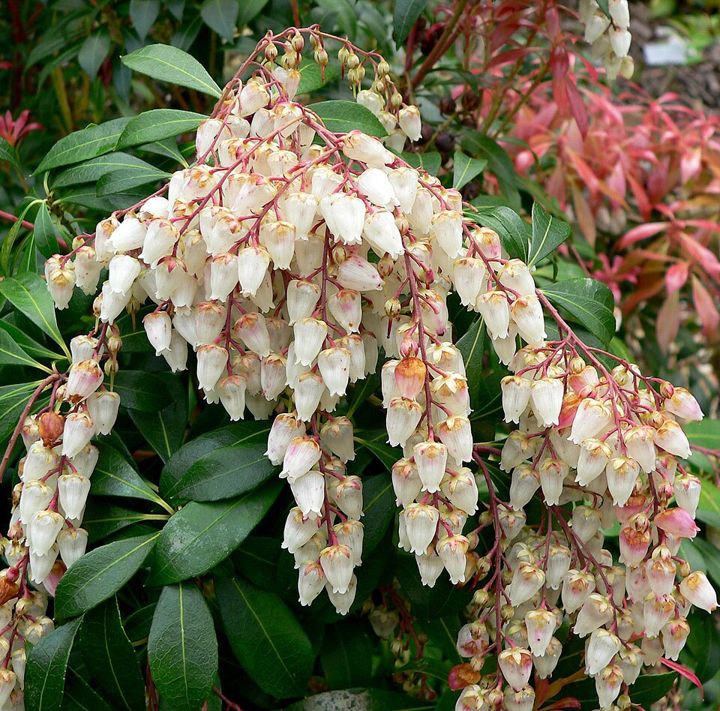
A medium-sized evergreen shrub or small tree 1–4 m tall, occasionally 10 m. Alternate simple leaves, obovate to oblanceolate, 3–9 cm with serrated margins, lustrous, leathery and dark green, the new growth a conspicuous bronze or red before turning green. Flowers from early to late spring in drooping trusses about 10 cm long of fragrant white or pink urn-shaped flowers 5–6 mm long hanging from the branch tips like strings of lily-of-the-valley; lasting two or three weeks. Poisonous throughout from grayanotoxins; the Chinese name says horses that eat it stagger drunk.
Habitat
Mountain thickets and open woodland, widely planted in gardens and parks; abundant in Nara Park, Japan, because the deer leave it alone.
Distribution
Native to eastern China, Taiwan and Japan; wild in the hills of eastern and central China and common throughout Japan, one of Nara's emblematic plants. Absent from Singapore.
Season and behaviour
Peak bloom in March and April, with red new leaves in April and May; the buds hang on the branches all winter, so there is something to photograph in the cold months too.
Photography tips
These are the FilmAnalysis editors' notes, not content from the sources.
The hanging strings of bells suit an eye-level or slightly upward view against dark green leaves, half a stop under for the small white flowers. Red new leaves and white flowers appear together, its own two-colour moment. Pieris with deer in Nara Park is the classic frame. Keep children and pets from touching flowers and leaves.
Photographic styles
Hanging strings of white bells; a spring of red new leaves.
Similar species
Pieris formosa (upright or spreading trusses, southern and south-west China); blueberries (short clusters, edible fruit); lily-of-the-valley (herbaceous, upright racemes).
Related badge
None yet. No validated photo recognition exists for this species, so no badge is tied to it: a name in the encyclopedia is not evidence in a photograph.
The illustration is original FilmAnalysis artwork. The photograph is from Wikimedia Commons; its licence and author are under it.
Why it is listed: this species comes from the Flower checklist (GBIF backbone and Wikidata verified). Names follow the GBIF backbone and Wikidata; the facts follow the sources below; photo recognition is not offered.