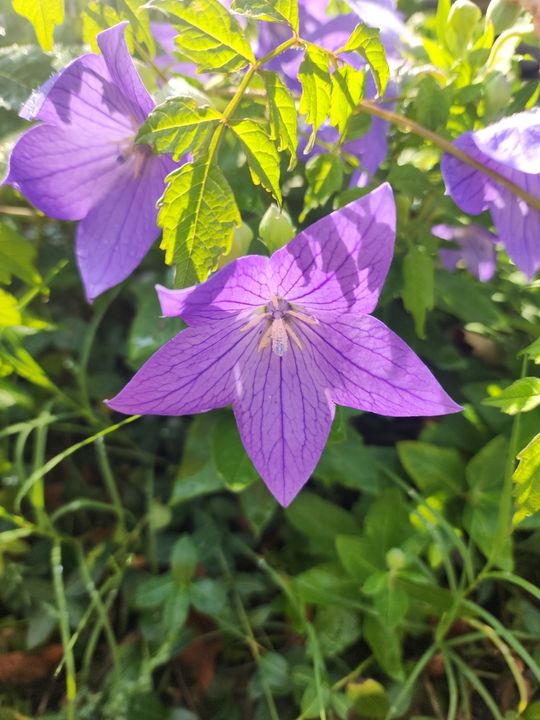
Photo: J.W. Suit-Darling, via iNaturalist, public domain / CC0. Unmodified apart from resizing.
Colour
blue, purple, white
Region
Japan and temperate East Asia
Season
summer
Shape
single flower
Identification
A perennial 40–100 cm tall with thick roots and stems that bleed white juice when cut. Leaves 5–12 cm, narrowed at both ends with toothed edges. The bud swells like a balloon, then the five fused petals split into a bell, the genus name meaning broad bell; flowers blue-violet or white, one to several at the stem tips in July and August. The only species in its genus. The root is medicinal, and root and young leaves are pickled, a famous Korean kimchi ingredient.
Habitat
Sunny hill grassland, forest edge and fields, widely grown in gardens and beds and farmed on a large scale in Korea and north-east China.
Distribution
Native to East Asia: most of China, Korea, Japan and the Russian Far East; common in the hills across China and throughout Japan, where kikyō is one of the seven autumn herbs and a family-crest motif. Absent from Singapore.
Season and behaviour
July to September, from June in Japan; swollen buds and open flowers stand together on one plant.
Photography tips
These are the FilmAnalysis editors' notes, not content from the sources.
A balloon bud beside an open bell is its most interesting frame, with side light for the veins on the bud. The blue-violet is truest under cloud and at dawn and turns pinkish at noon. The five-pointed star seen straight down is the most graphic view; half a stop under for the white form.
Photographic styles
Balloon buds with five-pointed stars; blue-violet in summer grass.
Similar species
Bellflowers (hanging bells that do not inflate); gentians (tubular, autumn, deep blue).
Related badge
None yet. No validated photo recognition exists for this species, so no badge is tied to it: a name in the encyclopedia is not evidence in a photograph.
The illustration is original FilmAnalysis artwork. The photograph is from iNaturalist; its licence and author are under it.
Why it is listed: this species comes from the Flower checklist (GBIF backbone and Wikidata verified). Names follow the GBIF backbone and Wikidata; the facts follow the sources below; photo recognition is not offered.