Singapore and tropical Asia, Japan and temperate East Asia
Season
summer, autumn
Shape
spike
Identification
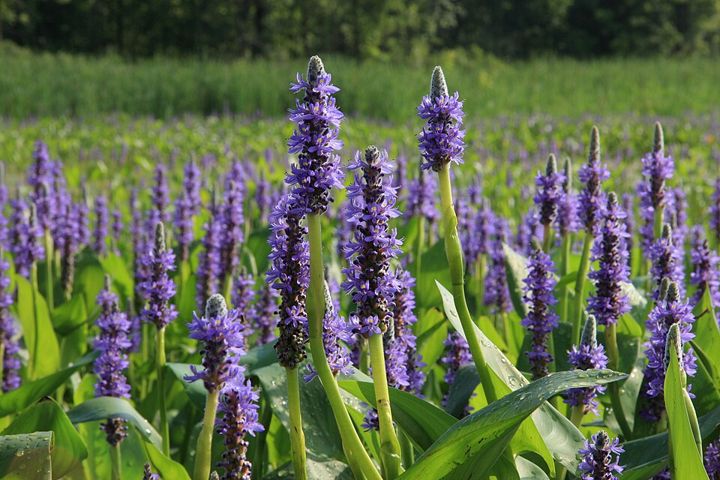
An emergent monocot aquatic with basal glossy heart-shaped leaves (the epithet means heart-shaped) on long stalks; an upright stem carries a dense spike of many small blue-violet flowers beneath a leaf-like bract, each flower six-lobed with two yellow spots on the upper lobe; a flower lasts a day and the spike several days. Aerenchyma in the stem carries oxygen to the roots, so it grows in flooded ground and tolerates low soil oxygen.
Habitat
Pond and lake margins, shallow river water and marshes, most where water levels fluctuate naturally; prefers fertile bays and dislikes salt. Grown as a water-garden plant in East Asia and escaped.
Distribution
Native to the Americas from eastern Canada to Argentina; introduced to East Asia as an ornamental aquatic, common in park ponds across China, grown in Singapore's wetland parks, and cultivated with scattered naturalisation in Japan.
Season and behaviour
June to October, peaking in high summer; each spike opens from the bottom upward.
Photography tips
These are the FilmAnalysis editors' notes, not content from the sources.
Blue-violet spikes stand clear of the water: a low viewpoint at the surface for spike and reflection, with a polariser to kill glare; blue-violet is truest in soft light. Macro for the yellow spots on a single flower. The glossy heart-shaped leaves become bright planes in side light behind. Dragonflies and damselflies perch on the spikes, 1/1600 s.
Photographic styles
Blue-violet spikes standing over water; dragonflies on a spike.
Similar species
Water hyacinth (floating, inflated leaf stalks, looser spike); Monochoria korsakowii (native, deep blue, looser, annual); Monochoria vaginalis (small blue-violet flowers, a paddy weed).
Related badge
None yet. No validated photo recognition exists for this species, so no badge is tied to it: a name in the encyclopedia is not evidence in a photograph.
The illustration is original FilmAnalysis artwork. The photograph is from Wikimedia Commons; its licence and author are under it.
Why it is listed: this species comes from the Flower checklist (GBIF backbone and Wikidata verified). Names follow the GBIF backbone and Wikidata; the facts follow the sources below; photo recognition is not offered.