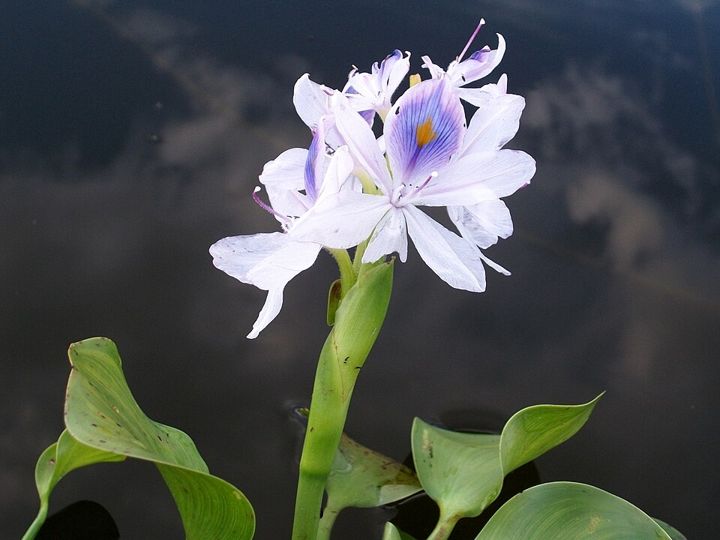
Photo: Ivandro batista de q…, via Wikimedia Commons, licensed CC BY 3.0. Unmodified apart from resizing.
Colour
purple, blue
Region
Singapore and tropical Asia, Japan and temperate East Asia
Season
summer, autumn
Shape
hanging raceme
Identification
A free-floating perennial aquatic with broad, thick, glossy ovate leaves 10–20 cm across on spongy stalks swollen into bulb-like floats, rising up to 1 m above the water. Feathery purple-black roots hang free. An erect stalk carries a spike of 8–15 conspicuous flowers, mostly lavender to pink, with six petals, the upper one marked yellow. One of the fastest-growing plants known, spreading by runners.
Habitat
Ponds, lakes, canals, slow rivers and paddies, covering nutrient-rich water in no time, blocking channels and starving the water of oxygen; a notorious worldwide invader, called the terror of Bengal.
Distribution
Native to tropical and subtropical South America, naturalised worldwide and often invasive outside its range. Very common on waters south of the Yangtze, naturalised from Honshu south in Japan, and present in Singapore's reservoirs and drains.
Season and behaviour
Flowers from July to October, each flower lasting a day or two while the spike goes on for several days; in high summer whole surfaces turn lavender.
Photography tips
These are the FilmAnalysis editors' notes, not content from the sources.
A flowering expanse compresses with a long lens into a lavender plane, or goes wide from low down with water and sky; a single spike wants a macro of the yellow mark on the upper petal. Against the light the petals glow violet, and a still dawn surface gives reflections. It is an invader: never carry plants to another water body.
Photographic styles
Water covered in lavender; the yellow-marked detail of one spike.
Similar species
Monochoria korsakowii (native, not floating, heart-shaped leaves, deep blue); pickerelweed (emergent, blue-violet spikes, arrow-shaped leaves).
Related badge
None yet. No validated photo recognition exists for this species, so no badge is tied to it: a name in the encyclopedia is not evidence in a photograph.
The illustration is original FilmAnalysis artwork. The photograph is from Wikimedia Commons; its licence and author are under it.
Why it is listed: this species comes from the Flower checklist (GBIF backbone and Wikidata verified). Names follow the GBIF backbone and Wikidata; the facts follow the sources below; photo recognition is not offered.