Japan and temperate East Asia, Singapore and tropical Asia
Season
summer
Shape
single flower
Identification
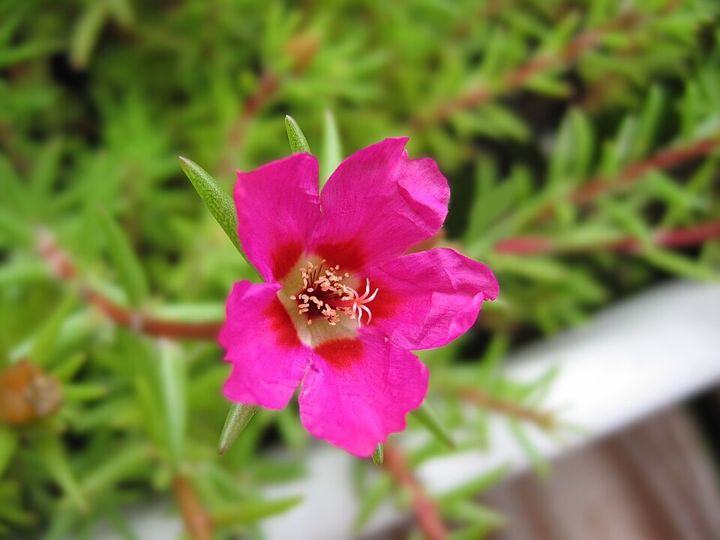
A small fast-growing succulent annual up to 30 cm, usually less; upright or ascending stems branching mostly at the base. Thick fleshy nearly cylindrical leaves 2–2.5 cm long and 2–3 mm wide, alternate or in clusters, with white woolly hairs in the axils. Flowers 2.5–4 cm across with five obovate petals, magenta, red, orange, pink, white or yellow, double in cultivars; eight to ten leaves surround the inflorescence. The flowers open only in sun and close in the afternoon, hence the Chinese names sun flower and noon flower; not a rose at all.
Habitat
Bed edges, wall tops, pots, rock gardens and sandy waste ground, extremely drought- and heat-tolerant and trivially easy from cuttings or seed; escaped in Jiangsu, Jiangxi and Fujian.
Distribution
Native to southern Brazil, Argentina and Uruguay; grown and escaped in warm regions worldwide, very common in beds and on balconies across China, common in Japanese summer beds (matsuba-botan), grown in Singapore's beds.
Season and behaviour
June to September, peaking in high summer; opening each morning and closing in the afternoon, each flower a day; all year in the tropics.
Photography tips
These are the FilmAnalysis editors' notes, not content from the sources.
Around ten in the morning it is fullest open: straight down for the five petals and central stamens; the colours are saturated and truest in soft light, magenta bleeding in strong sun. A mixed bed compresses with a long lens into a pattern of coloured dots. The needle-like fleshy leaves have texture in side light.
Photographic styles
Small colourful flowers from above in the morning; pointillism among needle leaves.
Similar species
Portulaca umbraticola (flat leaves); common purslane (a wild vegetable, small yellow flowers); double moss roses look like little roses.
Related badge
None yet. No validated photo recognition exists for this species, so no badge is tied to it: a name in the encyclopedia is not evidence in a photograph.
The illustration is original FilmAnalysis artwork. The photograph is from Wikimedia Commons; its licence and author are under it.
Why it is listed: this species comes from the Flower checklist (GBIF backbone and Wikidata verified). Names follow the GBIF backbone and Wikidata; the facts follow the sources below; photo recognition is not offered.