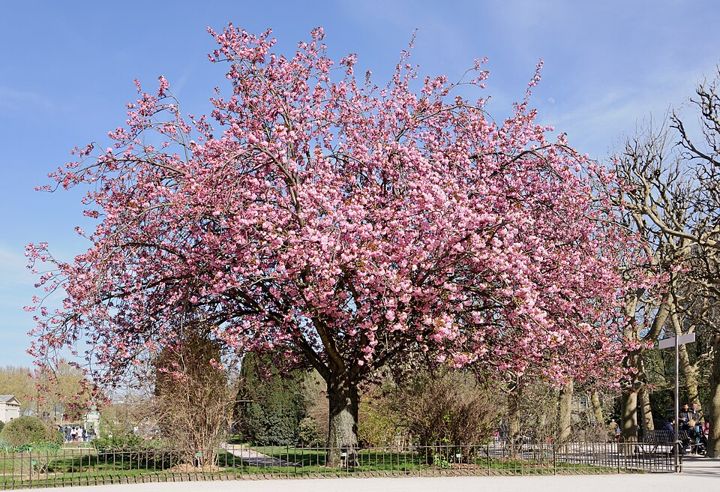
A tree 3–8 m tall with grey-brown to grey-black bark and hairless branches. Ovate-elliptic to obovate-elliptic leaves 5–9 cm with tapering single and double serrations tipped with small glands; dark green above. Flowers two or three in corymbs, white or pink, the petals notched at the tip, opening with or slightly before the leaves. Yamazakura means both this wild species and the many sato-zakura cultivars derived from the Oshima cherry (such as 'Kanzan' and 'Fugenzō'); most Japanese garden cherries are complex hybrids of several wild species.
Habitat
Mixed hill forest, forest edge and valleys, and widely planted in parks, on river banks and in temple grounds; the cherries of Mount Yoshino are mainly this wild species.
Distribution
Wild in Japan, China, Korea and Vietnam; common in the hills from northern to southern China and from Honshu south in Japan; the cultivars planted throughout the temperate world. Absent from Singapore.
Season and behaviour
Late March to April, slightly after the Yoshino cherry and together with the new leaves; the sato-zakura forms run into early May. About a week in flower.
Photography tips
These are the FilmAnalysis editors' notes, not content from the sources.
The wild cherry opens with its leaves, and the red-brown or green new foliage is what distinguishes it from the Yoshino cherry in a picture, so include leaves with the flowers. White-pink flowers have most depth under cloud; against the light the petals glow, half a stop under. Yoshino's thousand trees in one view compress with a long lens into patches of pink-white on the far hills.
Photographic styles
Wild cherry opening with its new leaves; pink-white on distant hills.
Similar species
Yoshino cherry (flowers before leaves, paler and more abundant); Oshima cherry (white, green leaves, scented); sargent cherry (northern, deeper colour).
Related badge
The album badge "cherry blossom" unlocks when the vision model explicitly names a cherry blossom in your photo and you rate the analysis. The badge stops at "cherry blossom": it does not tell species apart, and this page existing unlocks nothing.
The illustration is original FilmAnalysis artwork. The photograph is from Wikimedia Commons; its licence and author are under it.
Why it is listed: this species comes from the Flower checklist (GBIF backbone and Wikidata verified). Names follow the GBIF backbone and Wikidata; the facts follow the sources below; photo recognition is not offered.