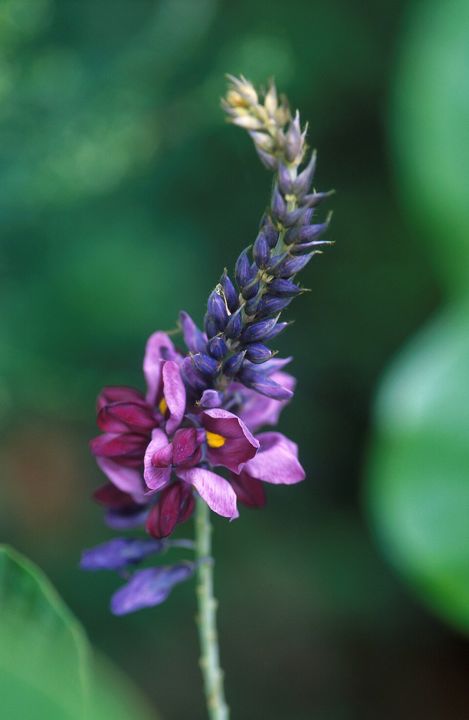
Photo: Peggy Greb, via Wikimedia Commons, public domain / CC0. Unmodified apart from resizing.
Colour
purple, pink
Region
Japan and temperate East Asia, Singapore and tropical Asia
Season
summer, autumn
Shape
hanging raceme
Identification
A perennial vine with tuberous roots and rope-like dark brown stems up to 20 m long, growing up to 20 m a year and reaching 30 m; the herbaceous stems are markedly hairy. Trifoliate leaves with large ovate leaflets of two or three lobes, hairy beneath. Purple-red pea flowers in upright racemes smell of grapes. It fixes nitrogen and runs riot on poor soil. At least three subspecies or varieties.
Habitat
Open scrub, hill woodland, forest edge, roadsides and waste ground, climbing anything vertical and carpeting the ground where there is nothing; a notorious invasive where introduced, especially the south-eastern United States.
Distribution
Native to East Asia, mainly the subtropical and temperate parts of China, Japan and Korea; common over most of China and all of Japan, where it is one of the seven autumn herbs; a plague after introduction to the United States. Singapore has the related tropical kudzu.
Season and behaviour
Flowers from July to September, the racemes hidden under the big leaves, so the grape scent is often noticed first; the leaves yellow in autumn.
Photography tips
These are the FilmAnalysis editors' notes, not content from the sources.
The racemes are usually covered by leaves: part them (do not break them) or shoot from below and to the side; the purple-red flowers contrast with the big dark leaves, and backlight makes the raceme glow pink-violet. Trees, poles and derelict houses swallowed whole by kudzu are another subject, for a wide lens.
Photographic styles
Landscapes smothered in vine; purple flowers under big leaves.
Similar species
Tropical kudzu (smaller flowers, shorter racemes, tropics); other Pueraria species (subtle differences, and they hybridise).
Related badge
None yet. No validated photo recognition exists for this species, so no badge is tied to it: a name in the encyclopedia is not evidence in a photograph.
The illustration is original FilmAnalysis artwork. The photograph is from Wikimedia Commons; its licence and author are under it.
Why it is listed: this species comes from the Flower checklist (GBIF backbone and Wikidata verified). Names follow the GBIF backbone and Wikidata; the facts follow the sources below; photo recognition is not offered.