Elsewhere (in East Asia only in bird parks or botanic gardens)
Season
year-round
Shape
large head
Identification
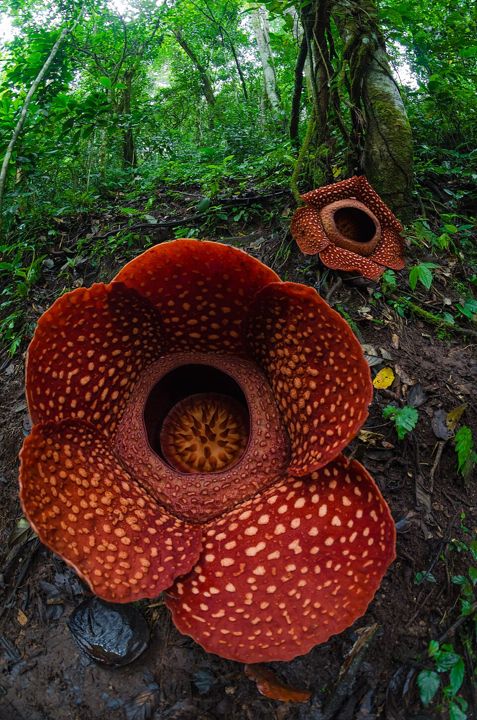
The largest single flower on Earth, about 1 m across and up to 11 kg. A holoparasite with no visible leaves, stems or roots and no chlorophyll, living like a fungus as thread-like tissue embedded in its host (Tetrastigma vines, chiefly T. angustifolium) and drawing all its water and nutrients from it, visible outside the host only when it flowers. Five fleshy reddish-brown petals spotted with white warts round a large central cup, stinking of rotting flesh to draw pollinating flies, hence corpse flower and giant padma; the flower is said to open with a hiss. A cabbage-like bud takes months to develop and the flower lasts only days. The epithet honours Joseph Arnold, naturalist of the 1818 expedition that found it.
Habitat
The rainforest floor of Sumatra and Borneo, on the roots and stems of Tetrastigma; it cannot be grown outside its home, and botanic gardens show only models and specimens.
Distribution
Native to Sumatra and Borneo in Indonesia; no living plants in East Asia (China, Japan, Singapore), with models at the Singapore Botanic Gardens and Gardens by the Bay. Guided viewing sites exist in reserves in Indonesia and Malaysia (Sabah, Sarawak).
Season and behaviour
Irregular through the year, a little more in the rains; a flower lasts five to seven days, freshest in the first two before it blackens and rots.
Photography tips
These are the FilmAnalysis editors' notes, not content from the sources.
Seen only with a guide in Borneo or Sumatra: forest light is very dim and the flower lies on the ground, so a wide lens from low, a stop over and a tripod, with a person's feet or hand beside the metre-wide flower for scale; macro for the white warts on the petals. Day two is the best; the edges blacken afterwards. Keep your distance and do not tread on the host vine.
Photographic styles
A giant flower framed with a person; macro of white warts on red-brown petals.
Similar species
Other Rafflesia (the Philippines, Thailand, the Malay Peninsula, smaller); titan arum (the largest unbranched inflorescence, another family); Sapria (in Yunnan, far smaller).
Related badge
None yet. No validated photo recognition exists for this species, so no badge is tied to it: a name in the encyclopedia is not evidence in a photograph.
The illustration is original FilmAnalysis artwork. The photograph is from Wikimedia Commons; its licence and author are under it.
Why it is listed: this species comes from the Flower checklist (GBIF backbone and Wikidata verified). Names follow the GBIF backbone and Wikidata; the facts follow the sources below; photo recognition is not offered.