Japan and temperate East Asia, Singapore and tropical Asia
Season
spring
Shape
cluster
IUCN status
Least Concern
Identification
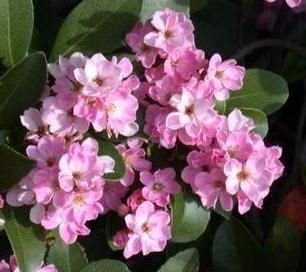
An evergreen shrub or small tree rarely over 4 m. Young branches purple-brown with brown tomentum, old ones greyish brown and smooth. Leathery leaves, ovate, oblong to elliptic-lanceolate, 4–8 cm, shiny above, pale beneath with visible net veins. Panicles or terminal clusters on rusty-tomentose stalks; flowers 1–1.5 cm across, white tinged pink, five-petalled with many stamens. Round purple-black fruits like tiny haws.
Habitat
Hillside scrub, coasts and streamsides, and widely planted as hedging and groundcover, tolerant of salt and clipping.
Distribution
Native to East Asia and Indochina: common in the hills of central and southern China and Taiwan, on the coasts from Honshu south in Japan (sharinbai), and planted as hedging in Singapore. The epithet Indian is a historical misnomer.
Season and behaviour
Peak bloom from March to May alongside the azaleas; the fruit turns purple-black in October and November.
Photography tips
These are the FilmAnalysis editors' notes, not content from the sources.
Small pink-tinged white flowers in clusters: soft light for the layers of a whole cluster, macro for the pink at the petal base and the red anthers; the gloss of the leathery leaves becomes bright lines in the background under side light. Purple-black fruit against waxy leaves is the subject of the other season.
Photographic styles
White-pink clusters among leathery leaves; the freshness of seaside scrub.
Similar species
Rhaphiolepis umbellata (thicker rounder leaves, coasts); firethorn (smaller white flowers, red fruit); Photinia parvifolia (white, toothed leaves).
Related badge
None yet. No validated photo recognition exists for this species, so no badge is tied to it: a name in the encyclopedia is not evidence in a photograph.
The illustration is original FilmAnalysis artwork. The photograph is from Wikimedia Commons; its licence and author are under it.
Why it is listed: this species comes from the Flower checklist (GBIF backbone and Wikidata verified). Names follow the GBIF backbone and Wikidata; the facts follow the sources below; photo recognition is not offered.