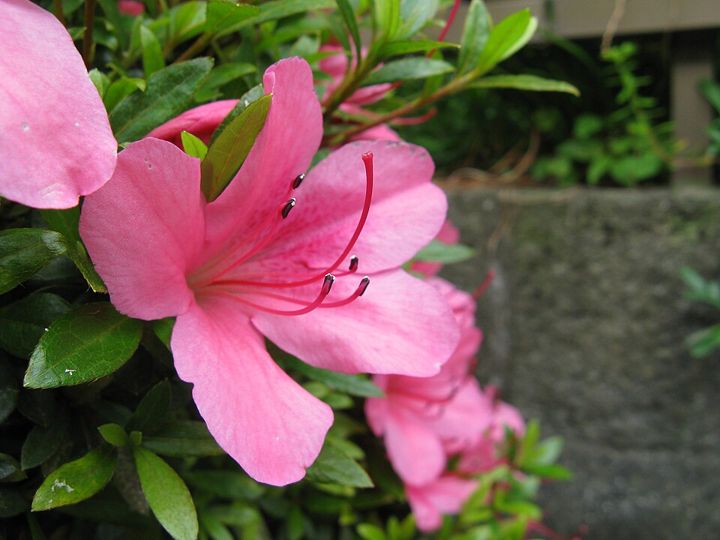
A low evergreen azalea with dense branches and small narrow glossy leaves, much used for bonsai and clipped into ball hedges. Funnel flowers red, pink or white, often several colours and stripes on one plant (the shibori prized by bonsai growers), opening in May, the fifth lunar month (satsuki), a month after other azaleas. Native to Japan and one of the core species of Japanese azalea culture.
Habitat
Crevices of riverside rock and streamside boulders, tolerant of flooding; planted in huge numbers in gardens, parks and street hedges, everywhere in Japanese public planting.
Distribution
Endemic to southern and western Honshu, Shikoku, Kyushu and Yakushima; planted throughout Japan as a garden plant and introduced to China (eastern gardens) and the world. Absent from Singapore.
Season and behaviour
Late May to June, after Sims's azalea, the street colour of early summer in Japan; two or three weeks.
Photography tips
These are the FilmAnalysis editors' notes, not content from the sources.
Clipped balls in full flower become blocks of colour and geometry with a long lens; multi-coloured and striped flowers on one plant want a head-on macro. Red bleeds in sun, so a stop under. A satsuki bonsai with moss and pot is the traditional still life, in soft light.
Photographic styles
Clipped balls as blocks of colour; many-coloured flowers in a bonsai.
None yet. No validated photo recognition exists for this species, so no badge is tied to it: a name in the encyclopedia is not evidence in a photograph.
The illustration is original FilmAnalysis artwork. The photograph is from Wikimedia Commons; its licence and author are under it.
Why it is listed: this species comes from the Flower checklist (GBIF backbone and Wikidata verified). Names follow the GBIF backbone and Wikidata; the facts follow the sources below; photo recognition is not offered.