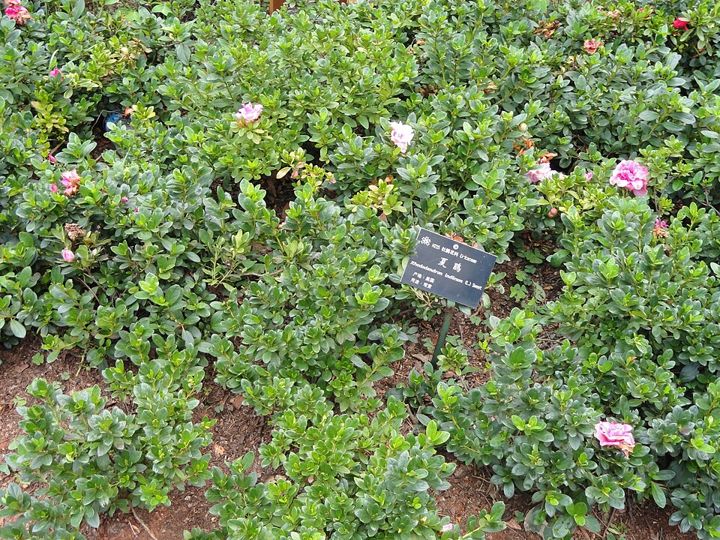
Photo: Daderot, via Wikimedia Commons, public domain / CC0. Unmodified apart from resizing.
Colour
red, pink, white
Region
Japan and temperate East Asia
Season
spring
Shape
cluster
Identification
A twiggy evergreen or semi-evergreen shrub to 2 m. Leaves ovate, elliptic-ovate or obovate to oblanceolate, 1.5–5 by 0.5–3 cm, bristly. Flowers two to six at the branch tips, funnel-shaped, white to dark red, most often scarlet or rose, with dark spots on the upper lobe and ten stamens. Some varieties contain grayanotoxin and are poisonous. The epithet honours John Sims, first editor of the Botanical Magazine. A main parent of the cultivated indoor and Belgian azaleas.
Habitat
Hillside scrub, open woodland and roadsides at 500–2,700 m on acid soil, flowering most in full sun and turning whole hillsides red in spring, hence the Chinese name that reflects on the mountain.
Distribution
Native to East Asia: the provinces south of the Yangtze (very common in Hong Kong), Taiwan, Vietnam and Thailand; Japan's wild azaleas are related species and this one is scarce there. Absent from Singapore. Rare in the West, familiar in Chinese gardens.
Season and behaviour
March to May, peaking in April with the hill flowers of Qingming; from late February in the south.
Photography tips
These are the FilmAnalysis editors' notes, not content from the sources.
A whole red hillside compresses with a long lens or goes wide to take the shape of the hill, softest in early mist; red bleeds easily, so a stop under and watch the red channel. Macro a single flower for the dark spots on the upper lobe and the ten stamens. Overcast diffuse light suits its saturation better than sun.
Photographic styles
Hillsides reflected red in spring; spotted macro of a red flower.
None yet. No validated photo recognition exists for this species, so no badge is tied to it: a name in the encyclopedia is not evidence in a photograph.
The illustration is original FilmAnalysis artwork. The photograph is from Wikimedia Commons; its licence and author are under it.
Why it is listed: this species comes from the Flower checklist (GBIF backbone and Wikidata verified). Names follow the GBIF backbone and Wikidata; the facts follow the sources below; photo recognition is not offered.