Japan and temperate East Asia, Singapore and tropical Asia
Season
year-round
Shape
single flower
Identification
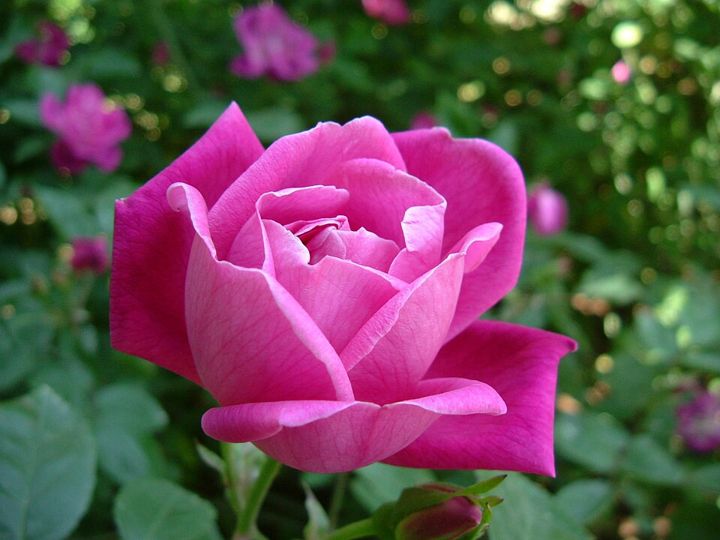
A shrub 1–2 m tall growing in hedges or thickets. Pinnate leaves of three to five (rarely seven) leaflets 2.5–6 cm long and 1–3 cm wide, ovate or ovate-oblong, sharply toothed, glossy dark green above; petiole and rachis sparsely prickly and glandular. Strong branches with smooth purplish-brown bark and from many to no curved, stocky, flat prickles. The wild form (var. spontanea) has five pink to red petals; cultivars are double and flower in every month, hence the Chinese name monthly red, and it is a main parent of the modern hybrid roses. Red hips 1–2 cm. First published by Jacquin in 1768.
Habitat
Hillside scrub, streamsides and hedges, and far more in gardens, beds, parks and streets; one of China's most widely grown flowers and the city flower of Beijing and dozens of other cities.
Distribution
Native to south-west and central China (Guizhou, Hubei, Sichuan); grown throughout China, and after reaching Europe in the eighteenth century the foundation of the modern rose; grown in beds and for cut flowers in Japan and Singapore.
Season and behaviour
April to November, in every season with peaks in May and October; all year in the tropics.
Photography tips
These are the FilmAnalysis editors' notes, not content from the sources.
There are endless ways to photograph a rose, and light matters most: soft light gives the layered petals depth, while direct sun always clips a red rose, so a stop under and watch the red channel. A half-open flower has more form than a full one. Dew at dawn and rain on the petals are best. A dark green background or a distant blur of other flowers. Note the difference from Rosa rugosa: the cut-flower rose is really this species.
Photographic styles
Soft-light portraits of half-open flowers; water drops after rain.
Similar species
Rugosa rose (wrinkled leaves, very prickly, coastal); multiflora rose (small clustered flowers); tea rose, Rosa odorata (yellow or white tinged pink, climbing, the other parent of the tea roses).
Related badge
The album badge "a rose" unlocks when the vision model explicitly names a a rose in your photo and you rate the analysis. The badge stops at "a rose": it does not tell species apart, and this page existing unlocks nothing.
The illustration is original FilmAnalysis artwork. The photograph is from Wikimedia Commons; its licence and author are under it.
Why it is listed: this species comes from the Flower checklist (GBIF backbone and Wikidata verified). Names follow the GBIF backbone and Wikidata; the facts follow the sources below; photo recognition is not offered.