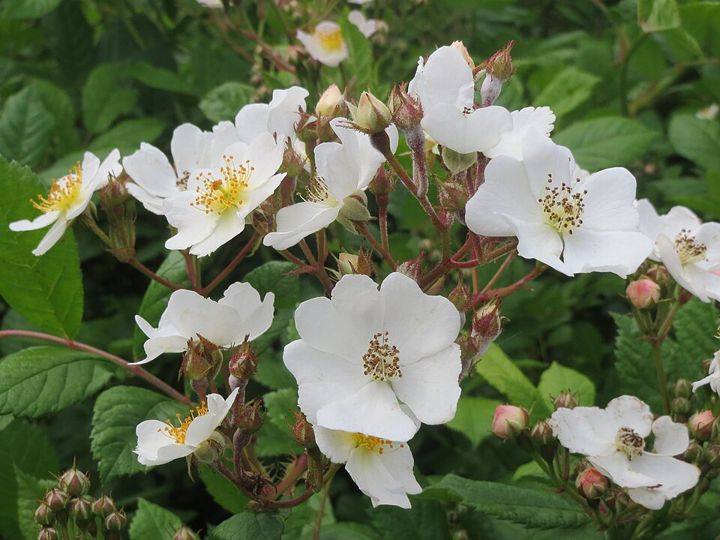
Photo: AnRo0002, via Wikimedia Commons, public domain / CC0. Unmodified apart from resizing.
Colour
white, pink
Region
Japan and temperate East Asia
Season
spring, summer
Shape
cluster
Identification
A scrambling perennial shrub climbing 3–5 m over other plants, with stout stems bearing recurved prickles (sometimes absent) and long arching canes that root at the tips. Pinnate leaves 5–10 cm long with 5–9 leaflets and feathered stipules, the best mark from other roses. Small flowers 1.5–4 cm across, white or pink, in large corymbs in early summer; the hips reddish to purple, 6–8 mm. One plant can set 500,000 seeds a year.
Habitat
Hillside scrub, roadsides, river banks, hedges and forest edge, hardy, the rootstock and parent of many garden roses; in North America an invader forming impenetrable thickets.
Distribution
Native to eastern Asia in China, Japan and Korea; wild from northern to southern China and common throughout Japan (noibara); invasive after introduction to North America. Absent from Singapore.
Season and behaviour
Peak bloom in May and June for about two weeks, the branches white with lightly scented flowers; small red hips crowd the branches in autumn and last into winter.
Photography tips
These are the FilmAnalysis editors' notes, not content from the sources.
Clusters of small white flowers want the sweep of a whole branch rather than one bloom, with side backlight through the petals and a dark background, half a stop under. The feathered stipules are the identification mark, worth one close-up. The red hips in autumn and winter are clean against snow or dead grass, and when birds come for them the picture becomes a bird picture.
Photographic styles
Branches white with early-summer bloom; small red hips in winter.
Similar species
Rugosa rose (large purple-red flowers, wrinkled leaves); China rose (large double flowers); Cherokee rose (large solitary white flowers, prickly hips).
Related badge
The album badge "a rose" unlocks when the vision model explicitly names a a rose in your photo and you rate the analysis. The badge stops at "a rose": it does not tell species apart, and this page existing unlocks nothing.
The illustration is original FilmAnalysis artwork. The photograph is from Wikimedia Commons; its licence and author are under it.
Why it is listed: this species comes from the Flower checklist (GBIF backbone and Wikidata verified). Names follow the GBIF backbone and Wikidata; the facts follow the sources below; photo recognition is not offered.