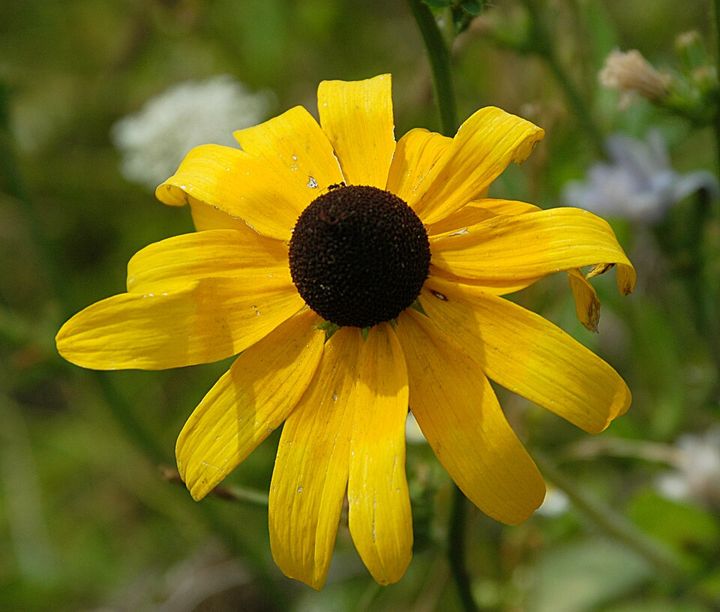
An upright annual (sometimes biennial or perennial) 30–100 cm tall and 30–45 cm wide. Alternate, mostly basal leaves 10–18 cm long covered in coarse hair; stout branching stems. In late summer and early autumn daisy-like heads up to 10 cm across, yellow rays round a conspicuous brown or black dome-shaped cone of many small disc florets, the black eye. Breeding has produced oranges, reds, browns and many sizes. The state flower of Maryland.
Habitat
Prairie, roadsides, field edges and borders in sun, the signature wildflower of the North American prairie; grown in borders and flower fields in East Asia.
Distribution
Native to eastern and central North America and naturalised in the west and every Canadian province; naturalised in China and grown in borders everywhere; common in Japanese beds (arage-hangonsō), scarce in Singapore.
Season and behaviour
July to October, peaking in late summer and early autumn; one flower lasts weeks.
Photography tips
These are the FilmAnalysis editors' notes, not content from the sources.
Yellow rays round a black eye are a ready composition, most graphic straight down, or from the side for the raised black cone; yellow clips at noon, so half a stop under, and the cone's detail wants soft light. A border compresses with a long lens into a yellow-and-black dot pattern. Butterflies come, 1/1600 s.
Photographic styles
Yellow petals round a black eye from above; the raised cone in profile.
None yet. No validated photo recognition exists for this species, so no badge is tied to it: a name in the encyclopedia is not evidence in a photograph.
The illustration is original FilmAnalysis artwork. The photograph is from Wikimedia Commons; its licence and author are under it.
Why it is listed: this species comes from the Flower checklist (GBIF backbone and Wikidata verified). Names follow the GBIF backbone and Wikidata; the facts follow the sources below; photo recognition is not offered.